A photo from the book (and that's on wiki)—
 |
 |

|
|
 FSA caption:
 Migrant agricultural worker's family. Seven hungry children. Mother aged thirty-two. Father is a native Californian. Destitute in pea picker's camp, Nipomo, California, because of the failure of the early pea crop. These people had just sold their tent in order to buy food. Of the twenty-five hundred people in this camp most of them were destitute.It's a different view of a family more familiar here—

It’s a good cop-bad cop charade. The Republicans are playing the role of the bad cop. Their script says: "You cannot raise taxes on anybody. No progressive income tax, no closing of tax loopholes for special interests, not even prosecutions for tax fraud. And we can get a lot of money back into the economy if we give a tax holiday to the companies and individuals that have been keeping their money offshore. Let's free the wealthy from taxes to help us recover."There's very much more, in Hudson's analysis of financial class warfare against all other segments of societies, and the havoc it has just begun to wreak internationally.
Mr. Obama can turn around and pretend to be the good cop. "Hey, boys, let me at least do something. I'm willing to cut back Social Security. I'm willing to take over what was George Bush's program. I share your worries about the budget deficit. We have to balance it, and I've already appointed a Deficit Reduction Commission to prepare public opinion for my cutbacks in the most popular programs. But you have to let me get a little bit of revenue somewhere."
In the end the Republicans will make some small token concessions, but they'll get their basic program. Mr. Obama will have sold out his constituency.
"The problem is, how can Mr. Obama move to the right of where George Bush stood? The only way he can do this is for the Republicans to move even further to the right. So the Republicans are accommodating him by pushing the crazy wing of their party forward, the Tea Party. Michelle Bachman, Eric Cantor and their colleagues are coming with such an extremist, right-wing attitude that it gives Mr. Obama room to move way to the right as he triangulates, depicting himself a the less crazy alternative: "Look. I'm better than these guys are."
... We're going into a depression that is unnecessary – except to drive down wage levels and strip away government obligations to pay for Social Security, Medicare and other public programs. This will enable the government to get rid of what remains of progressive taxation on the higher wealth and income brackets.In other words: Republican policies, promoted by a nominally Democratic president elected with a mandate for change—

Pea picker camp. This family had been farm owners in Oklahoma, lost their farm and for the last three years "have been draggin' our children around California. We're a have-to case."Why should Americans become too soft, when they can experience a character-building return to the old days?
Calipatria, Imperial Valley, California.

Migrant pea pickers on the road. California.Like pea eating, pea picking is a healthy activity.

Migrant pea pickers camp in the rain. California.This could be a bracing lesson in Back to Basics...

Pea pickers in California. "Mam, I've picked peas from Calipatria to Ukiah. This life is simplicity boiled down." California.And a big bonus: plenty of fresh air for the youngsters.

Children of migratory pea pickers in Brawley camp. California.

Father and son from Chicago picking strawberries in Berrien County, Michigan.I've written before about John Vachon's America, Miles Orvell's book on the photographer's life and Depression-era work.
John Vachon, 1940
Library of Congress, FSA/OWI archive
 A young (and non-smoking) sportscaster, poses for a tobacco company ad [1932-33].
 Cigarette Advertising Image Gallery

FSA (Farm Security Administration) borrower. Saint Mary's County, Maryland. 1940

Father and daughter at Tygart Valley Homesteads, West Virginia. 1939
 New Orleans, Louisiana. Negro dock worker and son. 1943
Worker at carbon black plant, Sunray, Texas 1942Missing his own family while on the road, his portraits of children suggest great rapport.
FSA/OWI color archive

Child of homesteader, Tygart Valley Homesteads, West Virginia. 1939

Daughters of a Tygart Valley homesteader. House and factory in background. West Virginia. 1939

Negro boy near Cincinnati, Ohio. [1942 or 1943]Vachon's letters written during a 1942 trip to Lincoln, Nebraska suggest a point, in Orvell's words
... when Vachon steps back and begins to sense a profound change in American society. He had always reacted negatively to what he called "the fat boys"—the local officials, elected or appointed, who pulled the strings in a given locale. Now he has been asked to photograph a graduation class, and he can see in these seedlings of the future America some of what he most dislikes, where he least expected to see it.Days before commencement, it was a rush to line up subjects before work could even begin. After college administrators had helped Vachon find different student types, he wrote his wife that, try as he might to like these young men starting their lives in the adult world, he found it impossible with some.
... essentially, the industrialist. He comes I gather from a banker family in Sioux Falls. That is his fence side. He will, eventually, aside from the war, end up as chief of personnel for the Nebraska Power Co. or something like that. What I most feel is that he is the kind of guy I would like to like, a lot, but can't. Must actually stay away from. And that makes me sad. Really sad. Because he is so many of the finest young men in the country. the smart boys, the college boys, the boys who will have the chance to run things. And it looks no good for the future when you see their complacency, their willingness for instance, to leave the Negro situation as it is. Nothing about that moves them at all. They are part of the backward pullers, they want to be status quoers. They want to be associated with the "men who made AMERICA."In this appraisal, Orvell finds "Vachon seems uncannily able to read postwar America in his subjects, a smug America aloof from 'the honest to god world' that Vachon—by now well traveled—has seen about him."
...[Jimmy Carter's] approach to unemployment: he's for the Humphrey-Hawkins [full employment] bill. If ever there was a design for fascism, that's it. Fascism was really the basis for the New Deal. It was Mussolini's success in Italy, with his government-directed economy, that led the early New Dealers to say, "But Mussolini keeps the trains running on time." The Humphrey-Hawkins bill calls for the same kind of planned economy, and that would mark the end of the free marketplace in this country.Along with his new ideology, Reagan had mastered right-wing history revision. After all, Roosevelt himself had been accused of "fascism" by wealthy opponents of his administration. Some of these—real admirers of Mussolini and Hitler—thought fascism was just the thing for replacing Roosevelt. And because veterans had served as European shock troops, who better to lead a coup than a Marine general, beloved by servicemen.

Foraging for food, city dump, Dubuque, Iowa. 1940

Eighteen year-old mother from Oklahoma, now a California migrant.
Dorothea Lange, 1937

Child of migrant berry pickers, Berrien County, Mich.In the midst of this, they do what Republicans always do: all they can to enrich the elite by making the weakest suffer.
John Vachon, 1940

Aberdeen, South Dakota.
John Vachon, 1942
 |
Cartoon ... Columbus, Georgia newspaper ... December 15, 1940 indicating boomtown and prosperity because of defense construction around Fort Benning.In the decades since Democrats lost the South, the disproportionate amount of guvmint cash going that way hasn't changed.
Photographer: Marion Post Wolcott
Library of Congress FSA/OWI Archive
The baggers will get behind it because they all think they're giving the most; if a couple of Repukes pick it up, the thing will amplify and wash up to the steps of the capitol. Of course it would never pass... But it might make a lot of coastal folks realize they’re getting screwed by the so-called heartland.More here—
I suggest we call this movement No Free Lunch. Are you with me? Hey, gang! New idear to make all those WELFARE QUEENS in teh blue state urban centars SUFFER FOR BEING LAZY!!!!! NO FREE LUNCH! Your state can't take out more than it puts in!!! I think Idaho would be first in line, or Texas.
After me: a conservative is someone who believes if anybody but himself can win the game, the game is rigged.
No Free Lunch. I'm telling you. They'll remember it: It started here at Sadly, No. Swept the nation. Alaska, most of the South, the core of the heartland, and some crackpot border states jumped hardest into the fray, demanding those freeloaders like California and New York get back only as much as they put in... only to discover the tit in their state was attached to the cow in another.Brilliant idea; too bad about how far those ever get.
We don't give a rap about taxation,Those were the days...
Long as legislators give the nation,
Syncopation!
 |
 |
 |

Dorothea Lange, Resettlement Administration [later FSA] photographer, in California. 1936During the 1960s many surviving FSA photographers, along with administrator Roy Stryker, were interviewed for the Smithsonian's American Archives of Art.
FSA/OWI Archive

Destitute pea pickers in California. Mother of seven children. Age thirty-two. Nipomo, California. 1936Javitz saw repeated use of single images as a decision by publishers—and museums—to give the public a simplified message, when in fact
Library of Congress - FSA/OWI Archive
... most of these still photographs were not taken as one picture ... they were taken for a picture essay or picture story. These photographers were skilled, and I should say it was sensitive enough a story so that they made no attempt to tell the whole story in one picture. And I think that one thing that comes over from FSA pictures is that there are no isolated images. The image is a part of a long continuing tale. You meet the coal miner squatting waiting for the bus, you see him walking toward his house, you see his children, you see him on the porch, you see him going to work, and you just feel this thing is a non-isolated image, and nothing will hurt that feeling or take away from it except museum shows. I have a prejudice, as you notice. I am trained as an artist, my education is that of a painter. Of course, I couldn't have lived without a museum [but] I think museums are extremely snobby in their attitude towards the intelligence of the public ...On the importance of FSA work in documenting American life, Javitz observed that ...
when the FSA... photographs came to us, they just gave us a complete new eye. ... it was the first time that we had images that were clean-cut. They weren't made to sell records or soap or whatnot. Before that, our pictures were very tainted by commerce from the point of view of selling. They were pretty-pretty, they were Saturday Evening Post ... Remember that even the Civil War photographs that were available were slight. ... the Rotogravure sections of the newspapers ...[were] photo-journalism before Life and Look. We had any amount of material on society because of the Rotogravures and Harper's Bazaar, Vogue, Vanity Fair, all those magazines and the inflation of the twenties. We can give you what the society woman would wear on the Riviera and what her dog looked like in Southampton. But we couldn't find a sunbonnet ...The Civil Rights Act had been passed in 1964, just months before this interview, and Javitz notes how the FSA recorded conditions that could only lead to a movement for equality. The photographic record also showed, she observed, how the face of extreme poverty had changed little since the Thirties.
... America showed ... the world that we are not afraid to look at ourselves and we are not afraid of recording what we look like, and also we should show the world that we have a sense of history ... Nothing is as important today as a knowledge of the past, and we have certain records of the past, that are constantly available, but they're distorted because so little of it is true and so little is contemporaneous.There's a profound cultural loss in how far the country has been pushed from this ideal.
 |
| Iowa : WPA Federal Art Project |
Because Vachon worked for the FSA-OWI as long as did, his work forms a narrative from the despair and desolation of the Depression to the energy and mobilization of World War II.
 In the summer of 1935, Walker Evans began the first assignment of his WPA employment: traveling through West Virginia to document homestead and cooperative projects initiated by the RA. In Belinda Rathbone's account, Evans found himself in a setting ideal for the approach he had been developing—
 In the mining towns, deserted and depressed... the small company towns sprawling over the landscape, once thriving, now bankrupt, he saw through the American dream of an egalitarian society to its core of melancholy.
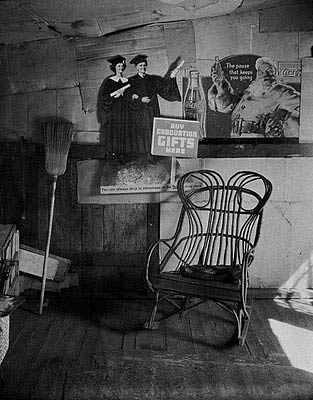 |
| Scott's Run mining camps near Morgantown, West Virginia. 1935 |
Evans also had an intuitive grasp of the ad world, a sense of the immediate present, and a talent for puns and double-entendres much like his father's gift for the catchy phrase. But unlike his father, he... [had] a sense of the emptiness and pathos that such things so quickly acquire with age.Vachon's work also captures that "core of melancholy"—
 |
| Shack on the edge of the city dump, Dubuque, Iowa. 1940. |
 |
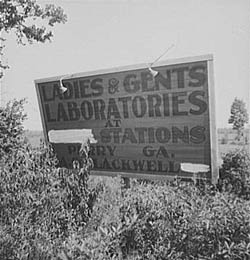
| Advertising, Woodbine, Iowa. 1940 |
 |
| Cincinnati, Ohio. 1938 |
 |
| National Association of Manufacturers sign, Dubuque, Iowa. 1940 |
Bill posters; sign painters — crowd watching a window sign being painted, ... parade watching, ticker tape; roller skating; spooners — neckers; mowing the front lawn... the kind of things that a scholar a hundred years from now is going to wonder about.While employed by Stryker, Evans characteristically worked at his own pace. He stalled on deadlines and fended off Stryker's nagging about trip expenses, until finally turning in work to fit his assignments. During his tenure Evans managed to collect enough pay to keep going—no small accomplishment for the times—while pursuing his own vision. This included Evans' and James Agee's 1936 trip to rural Alabama, where they undertook the work that would become Let Us Now Praise Famous Men.
His general note is lyrical understanding of the street... trained observation of it, special feeling for patina, eye for revealing detail, over all of which is thrown a poetry which is not "the poetry of the street" or "the poetry of Paris," but the projection of Atget's person.For Evans, Atget evoked the "difference between a quaint evocation of the past and an open window looking straight down a stack of decades." This insight, writes Rathbone, was Evans' approach to analyzing "the elusive element of time in photography, which Atget had so mysteriously mastered."
In drawing a distinction between the sentimental photography of the preceding generation and the pure documentary style that would soon overtake it, Evans made notable use of the metaphor of an open window and evoked a penetrating vista down through a "stack of decades." The receding vista, common to many of Atget's photographs, was becoming a particular interest of his. ...That his photographs saw through windows and porches and around corners gave them a new dimension and power and even an aura of revelation. They seemed to bring him closer to seeing into the past. In an old house in Copake, New York, he made a picture through one small room into another, which suggested a secret conversation between the dresser, the chair, and the Victorian portrait on the wall.
Like Atget's views of old Paris, Evans' photographs quietly animated the inanimate.
 |
| Church interior. Alabama or Tennessee. 1936 |
...I contribute, through my work with the magazine, to the thinking and forming of values which spread out from these stone buildings to the pliant acceptors of this false, refined civilization... though I say, truthfully, that I reject this civilization, and had rather been no part of it... I nevertheless rejoice in it, and pander to it, as I fly out in early morning airplanes to photograph a famous ballplayer in Evansville, Indiana, or to see a senator in Washington or Maine.Orvell notes Vachon's attraction to the chance encounters of urban settings. In the evolution of the work, Orvell sees a link from the documentary approach of the Thirties, to the Fifties "snapshot aesthetic" of photographers like Robert Frank and Lee Frielander.
"'Downtown': A Last Look Backward," published in the August 1956 issue... Evans warned his readers that the district [lower Manhattan] would never be the same once a score of new construction projects then underway was completed. "The building boom now commencing," he predicted, "will change the face, and a good deal of the atmosphere, of the entire district."Rathbone concludes that—
...in March 1957, Evans produced "Before They Disappear," a photographic homage to the freight-car emblems he had loved since childhood. The portfolio, in color, showed the respectful attention to detail of a boy stamp collector; Evans knew when each emblem had first appeared and how it had been modified over the years..."
While he mourned the loss of... treasures of his childhood, he argued vehemently against the idea that his photography might be driven by nostalgia... It was a sense of history in the rough he cherished, a sense that he had been better able to master in the days of the Depression, when America's material progress had stalled and the world stood still for his camera, poised for change. In the 1950s, an era that was loath to look backward, the meaning of Evans' enterprise hovered between one misinterpretation and another. He was not an aging social protest artist, nor was he a dewy-eyed sentimentalist. But there seemed to be fewer people around who knew what he was.It was in the time when "the world stood still for his camera" that Evans' work was at its most affecting, and that the era found perhaps its greatest artist.
 |
| Fireplace in bedroom of Floyd Burroughs' cabin. Hale County, Alabama. 1936 |
The Federal Theatre Project: A Case Study
Barry B. Witham, 2003
 |
George Mason University Libraries |
Flanagan was energetic, dynamic and ambitious. Like many of her contemporaries, she was also idealistic about the power of the arts to compel and humanize. She believed in the idea of a Federal Theatre and was excited about its potential to entertain and to instruct. It had the power in her imagination to transform both the kind of the theatre for which Americans yearned and the audience who would benefit from that transformation.Witham, professor of theater history at the University of Washington, makes a convincing case that
The plan was flawed, of course, because the government money came with significant complications. In order to be eligible for the theatre payroll, people had to qualify for unemployment: that is, the real test of their theatrical talent was often their relief status. There were exceptions. Individual units could "exempt" up to 10 percent of their employees... to insure a degree of "professionalism." But Federal Theatre would always host a struggle between those who were "right for the part" and those who qualified for relief. In addition, production costs for essential items such as paint and canvas had to be raised at the local level. The hope was that, like other WPA projects, local business or communities would"sponsor" individual projects and help to defray production expenses. That was a stumbling block, especially for units outside large metropolitan areas...
Operating within the framework of the WPA agenda and struggling constantly to accommodate regional and local interest and impulses, Seattle is a unique lens for examining the complex character of Federal Theatre and for illuminating its multiple dreams and disappointments.Those struggles included negotiating layers of WPA bureaucracy at both national and state levels—sometimes successfully, sometimes not. And local rivalries were at work among theatrical factions as well as political ones.
...believed that the camps were natural venues for touring units, and the programs could be provided for free without complaint from private enterprise. In addition the camps, frequently located in isolated outposts, were eager for visitors and provided enthusiastic audiences. And those audiences were people whom Flanagan wanted the project to reach.Witham notes, too, that
The CCC was one of the great success stories of the whole WPA enterprise. Founded originally in 1933, the camps survived throughout the entire decade in spite of considerable controversy... they were originally opposed by conservative forces and private enterprise. Organized labor believed them capable of preparing a huge apprentice labor force which would "flood the market" or of establishing the "dollar per day" wage as some kind of benchmark for skilled union workers. Antimilitarists and isolationists objected to the army supervision of the camps although the War Department was a logical choice to deal with the logistics of preparing hundreds of barracks... But as proponents of the CCC repeatedly pointed out, the service was voluntary, the rewards were for families on relief, and the projects from tree planting to fire fighting were laudatory.Seattle's CCC Revue groups roughed it, through long hours of travel over primitive roads and overnight stays in the spartan camps.
...Variety had played to a total audience of approximately 62,224 people and had traveled 14,000 miles. In prisons, orphanages, schools, soup kitchens and on dozens of improvised stages they had performed their routines carrying their own sets and costumes. This unit, Power points out, has traveled over a thousand miles every month by "truck, automobile and streetcar" and been most enthusiastically received.Around the country, too, Variety formed the basis of the FTP's early years. From this beginning, Seattle's program branched out to include some impressive achievements, along with some ambitious plans that were not to be realized before Congress killed the project.
 |
| GMU Libraries |
...a shrewd move... and a victory for Federal theatre, but once more the Negro Company — the most successful of any of the Seattle units — was abandoned. This time, being left on their own proved to be exhilarating.Selected poems were set to music, and organized into a framework to tell Dunbar's story. A draft took shape, but the performance space was a problem: what had become the home of Seattle's Federal Theatre was a cramped former movie house in an unfavorable location.
That summer of 1938 the twenty-three surviving members of Seattle's Negro Company began planning a new production. Although they had cursory supervision from Edwin O'Connor [local FTP's last artistic director], they were now creating their own work and making their own artistic decisions. They chose for this venture the life and poetry of Paul Laurence Dunbar, widely acclaimed as America's first African-American poet...
...[actor/director Joe] Staton made the final casting decisions himself, and the company continued to revise and polish the script and score. They sought out "old-timers" in the community and questioned them about church behavior in the ante bellum South as well as dance steps and manners. Staton found a former chain gang member who talked to them about call and response singing. In late October they completed a third major revision based upon actors' suggestions and improvisations, and [composer/music director] Howard Biggs wrote additional music to cover some of the more complicated transition moments. "An Evening With Dunbar is really beautiful," O'Connor wrote to [West region FTP director] Howard Miller. What's more, it had the largest advance sales of any production since they had moved into their consolidated home.
They opened on October 31, 1938 to lavish critical praise. Reviewers commented on the rich ensemble playing as well as individual performers... But it was Biggs who received the most attention, not only for the orchestrations but his superb direction of the choir. "Thunderous was the applause that greeted Howard Biggs who wrote the music and conducted the thirty-piece band during the play. His conducting of the chorus was also a thing of beauty to watch..." Biggs was finally recognized for the impressive work that he had been doing on the Project... Reviews also commented on the spirited staging, the wonderful party scene complete with dazzling costumes and Staton's direction.
 |
| University of Washington Libraries, Special Collections Divisions |
... of humor there is aplenty in an entirely unprecedented party scene, in the unaffectedly joyous antics of several budding character artists and other bits that ring true to a typical funsome Negro – because the entire offering is arranged, acted, sung and played by negroes, giving vent to their natural flair for "play actin'" and to their natural love of idolization.The program credited Joe Staton as director, "under the supervision of Edwin G. O'Connor." In the official production report filed with the national office, Staton was designated "assistant director."
...it is dispiriting to see the ways in which their accomplishments were demeaned, undervalued or appropriated at the very moment that they had created an original work, a work rooted in three years of ensemble playing and the individual talents of this very unique group. As long as they were the Negro stereotypes happily playing out the natural abilities of their race, however, it seemed difficult to recognize them for what they had become: a truly talented company enacting Hallie Flanagan's original fantasy of what Federal Theatre might be.By 1939 opponents had succeeded in defunding the program. While some of the rhetoric may have been more elaborate than that of our more recent de-funders of art, the sentiment is familiar. Witham quotes critic George Jean Nathan in 1938:
at least three-quarters of the younger people who have been living off it are spongers and grafters and no more deserving of charity from this particular source than they are deserving of Civil War pensions or Congressional dispensations of pate de foie gras. They have clearly demonstrated that they have nothing to give to the theatre — whether in the way of playwriting, producing, acting or scene painting — beyond a puissant and understandable itch to shine in easy and romantic jobs. With no faintest competence whatsoever, and infinitely better suited to humbler and more prosaic work, they are simply stagestruck and theatre struck loafers, and the Federal Theatre Project recklessly affords them opportunity to pleasure their fatuous whim.In the end,
Federal Theatre did not fail. It was stopped... By many criteria it succeeded beyond expectations, perhaps even beyond Hallie Flanagan's. In a depressed economy... the Arts Projects... provided jobs for the workers in the arts just as its parent organization, WPA, provided jobs for workers on the roads and in the forests. In dozens of cities across the United States actors, directors, designers and stage hands were paid a weekly wage by the federal government to produce plays. And thousands of those plays were shown free to their audiences. Other productions had modest admission fees, fees that were eventually funneled into production costs. For a program that was routinely characterized in the press and public media as "boondoggling," it is instructive to remember that federal theatres earned $2,018,775 at their box offices.From Witham's post-mortem on the local Project:
It was a national theatre not only because it was located in many states but because it aspired to reach out to a wider audience and to represent their experiences on stage. Children, workers, Jews, Hispanics and African Americans were all part of the vision and the demographics of the Federal Theatre... The Negro units, in spite of the controversy surrounding their leadership and conrol, were groud-breaking institutions in the American theatre whose influence and accomplishments are still being evaluated.
...Federal Theatre in Seattle never discovered (or perhaps agreed on) who its audience was... Many of the well-established "New Dealers"... were opposed to socio-political issues... Others, such as Florence James, however, wanted a theatre more in keeping with Flanagan's often-stated notion of a relevant and committed institution. And many others were content with box office and good show business regardless of the politics involved... The repertory reflects the tensions. With a powerful Negro Company, what could have been a more exciting choice than Big White Fog, for example? But each time it was considered it was ultimately discarded in favor of something with more song and dance.Of real importance, Witham concludes, was that
Federal Theatre made a space for actors to perform for audiences in a time and place where they weren't before... their achievement was that they were there, and they were paid for their labor with a modest salary, audience approval and their own self-respect.A look at WPA posters done for theatre projects around the country suggests that, along with vaudeville and circus, was some intriguing work.
 |
 |
 |
Theatre Arts in the Great DepressionWashington State History Link:
Federal Theatre Project in Washington State
Negro Repertory Company
Federal Theatre ProjectFrom UW American history professor, Quintard Taylor's site:
Negro Repertory Company
Negro Repertory Company (Seattle) 1936-1939After writing for the Negro Repertory Company, Browne ["Brown" in Witham's book] moved east, where he became a founding member of the Harlem Playwrights Company in the 1940s and later an academic.
Theodore Browne


