Showing posts with label Reagan - PR From Beyond The Grave. Show all posts

12.30.2011

Tools

If not the sharpest in the drawer, they served their purpose fully.

As the guy on the left will continue to, what with the PR machine endowed in perpetuity.

8.13.2011

The Role Of A Lifetime

A solemn 50th anniversary today.

Reagan's 1987 speech at the Berlin Wall would be the opportunity of a lifetime for right-wing propagandists.

Not that Reagan wasn't sincere about what he said. But after the Wall actually had come down, the noise machine claimed cause and effect. The media, of course, have promoted the ridiculous story line ever since.

Just another reason we are the source of laughter and head-shaking throughout the rest of the world.

5.01.2011

May Day: Cult of Personality - Precedents

I have in my possession a 2003 Reagan Ranch calendar, on the theme: "Lessons In Character From A Great American Leader."

Seeing as the ranch is operated by "Young America," our country's youth sure must be flush with cash.

Back of calendar text:
In 1998, Young America's Foundation saved the Reagan Ranch – Ronald Reagan's home fro 24 years and his favorite place on earth. This historic presidential property will be kept exactly as it was when the Reagans lived there.

Ronald Reagan worked with Young America's Foundation since his days as governor of California. He wanted to ensure his pro-American values – especially free enterprise, personal responsibility, limited government and a strong national defense – would be passed on to young people. With help from generous supporters, Ronald Reagan's beloved Rancho del Cielo and the new Reagan Ranch Center in Santa Barbara will serve as the focus of continuing the Reagan Revolution for generations to come.
Those "youth" are a very thinly disguised version of the original YAF. While I've seen some conflicting information as to whether the groups are independent of each other, that seems an intentional obscuring for tax/political status purposes.

Not only do the Jungend seek to inspire their fellow Youths with such well-funded, slick [if lame] PR, but the subject of their adoration provided the paint-by-numbers for a certain successor to follow—and to do up Texas-style.

Just compare: 345 days of "work"/vacation?

A mere piker, compared to someone else's 487 + 490...

Reagan, at least, really liked horses.

While that other guy had to acquire a ranch in time for his campaign.

We are asked to believe that Reagan spent much "leadership" time on his "favorite form of relaxation" Fast forward to "brush cutting"... (A manly activity the WaPoo endorses.)

Considering all these books—and some of the types who wrote them—how could Reagan's intellectual stature ever have been in doubt?
Some 2008 news from the WaPoo's Richard Cohen: based on the most reliable of sources (Karl Rove), Cohen reports that "Bush is a prodigious, industrial reader, and this does not conform at all to his critics' idea of who he is."

Exactly as government stopped being evil for as long as he could run it, Reagan was no phony politician... No, he was a humble man who appreciated simple, presidential-branded clothing ... like the humble President jacket (left) and The White House polo shirt (right).

Well, whaddaya know: today is the flight suit anniversary, which rolls around every May 1.

That particular eight-year PR production—with its logo apparel for every photo op—took its lessons from the master.

And there's this item...Make that: the Cowboy Chapter of the FCA...

Hanging around an "open cathedral"? That sure saved Reagan from actually setting foot in church; see, for example, quote at end of this.

If this advertising his "faith" didn't exactly set a precedent in American politics, Reagan got his party's connection to fundamentalists underway.

Among other abuses in this century (so far), we've had a Republican administration install theocrats at every level of government, while laundering money to "faith-based" political allies.

Just a small sampling (through about half of the second term) is here.

Ronald Reagan: a man you'd like to share a stein with So like the other guy.

1.01.2011

That Old, Familiar Feeling

This year, I'll be citing Paul Slansky's invaluable guide to eight years of Reagan & Co.: The Clothes Have No Emperor: A Chronicle of the American '80s (1989).

Read almost thirty years later, Slansky's introduction is indeed heavy on the déjà vu.

There's the familiar reaction to White House tenure of someone whose residing there was once unimaginable —
This book is a work of self-defense.

It is the response of one observer who realized that his perception of the truth - an actor is playing the President - was a distinctly unpopular one. An observer who saw his nation's history being fictionalized as it occurred - an actor is playing the President! - while the ratings race turned media "watchdogs" into accomplices, bit players in the hit TV show the Presidency had become. An observer whose very sanity was threatened by the ease with which illusion - an actor is playing the President! - was embraced as reality.

I did not find the President's ignorance charming. I was unwarmed by his genial headwaggling, unreassured by his stern frowns of manly purpose, uncheered by his hearty waves as he strolled to and from his limos and choppers and jets.

His smooth purr did not soothe me. His nostalgic fables about an America that never was did not inspire me. And his canned one-liners, perversely celebrated as "wit" ("If I'd gotten a hand like that in Hollywood, I never would have left") definitely did not amuse me.

... To me, the President was a pitchman who seemed not to exist when the camera light was off, a front man so personally invisible that he'd actually called his autobiography Where's the Rest of Me?, an aging star who'd spent way too much of his time watching his own movies, like Norma Desmond in Sunset Boulevard.
There's the familiar compulsion to record what's really happening—
Astonished that so few seemed to share my vision, I was compelled to document it. Armed with scissors, file folders, yellow highlight pens and a bank of VCRs, I embarked on an eight-year quest, gathering evidence to prove my case: AN ACTOR IS PLAYING THE PRESIDENT!

I began reading four, then six, then eight papers a day (and five, then 10, then 20 magazines a week), seeking out the absurd and the outrageous, clipping and filing everything that confirmed my sense that standards were falling across the political, social and cultural landscapes. I became a media prospector, mining vast acres of ink in search of the perfect details and telling quotes that held the golden nuggets of truth. I began a video file, recording the evening newscasts - first one network, then two, then three - and dubbing the key soundbites onto meticulously logged master tapes. The events of the decade were like a surreal novel unfolding in the media, and I found myself scrambling to get it all down, compiling a memory for a nation that clearly didn't want one.
Ah yes: it brings me back to 2000, and the eight long years that followed...

But I had the Web for finding information. With so many online sources trying to get out the truth, plus my own compulsive urge to record the history, I printed and accumulated file drawers full of paper.

Then, as blogging came along in the years after 2000, I found more online writers who gave voice to my anger and frustration. The Bush administration launched—if not a thousand blogs—plenty; and plenty of talented writers who felt compelled to track what was happening each day.

Blogs provided even more stuff for me to print and save, what with their astute commentaries and links to even more sources of information.

I still spend far too much time trying to clear my living space of the volume of paper left over from those years. But, I finally put a lot of the 2004-2008 material to use when, just before Obama's inauguration, I started writing about life in an office full of right-wingers during Bush's second term.

Slansky ends his 1989 introduction with a prediction—
Yes, The President Reagan Show is off the air now, but a similar entertainment - Dan Quayle's Playhouse - is waiting in the wings. As we head into the '90s, the powers that be are working overtime - with the complicity, once again, of segments of the media that surely know better - to lull us into thinking that our Vice President is "growing" into his office and will soon be ready for bigger things.

Do not assume that this lightweight can never be elected to the White House. Back in the '60s, we knew the very notion of "President Reagan" was preposterous.
If he was wrong about Quayle in particular, he was of course correct about the general principle at work.

And certainly correct about who could be "electable"; or, eligible for insertion into office—especially with a little nudge from the extra-electoral help always available to Republicans.

2012 looms, and considering the dizzying speed at which the "how low can we go?" standard keeps dropping... The easy marketing target that is a segment of our low voting population... How good the Republicans are at foisting their creations on the country...

Coming Attractions

Another tawdry sort of amusement is on its way, as the teabaggers entering Congress put the true face of the Republican Party on view.

And, non-believing as I am, this year is on the long list of reasons for believing that God does exist—
and is Republican:
February 6, 2011 marks the 100th anniversary of the birth of St. Ronald Reagan.
It will divert attention from the antics of those teabagging heirs to Reaganism; after all, the propaganda machine has been working on this year's rollout for a long, long time.

The show starts today; from the Reagan Foundation/Library—
Make sure to watch this year's 2011 Tournament of Roses Parade, which will include a float honoring the life of and legacy of one of America's heroes, President Ronald Reagan. This is the first ever presidential-themed float to participate in the annual parade. Entered on behalf of the Ronald Reagan Presidential Foundation, the float theme showcases the official parade theme, "Building Dreams, Friendships and Memories." President Reagan’s life and legacy inspired freedom, and contributed to lasting change across our country and around the world.
With the sleek visuals that will be fed to broadcast media, I'm bracing myself for Morning in America, He Won the Cold War, etc., etc., ad nauseum.

Throughout this year, I plan to revisit as much as I can of the reality of the Reagan years.

In trying to research aspects of that period, I'm finding that it has to be done pretty much the old-fashioned way: by going to books.

If I know of a specific newspaper or magazine piece from the time, I can look for that, but the material is not always available to a general reader (I do have access to Lexis).

Also, there are recent pieces online from expected sources; a search of "Reagan worst president" yields Robert Parry. Parry's piece at least comes up before the inevitable RW link to the glorious Reagan record, versus that of the horrid Dem presidents.

But general surfing for anything critical—or for just about any topic added to Reagan's name—is another story.

The usual result: page after page of book titles in the ever-growing Reagan hagiography; material by Reagan-dedicated foundations; and all manner of propaganda by the wing-nut welfare network. Just as intended: this is what the general public—or someone too young to remember the guy—will most easily find online.

So, there are those musty old books to consult.

A situation which, Clever Sister points out, could change fast.

In libraries all over, Decision Makers are getting rid of print, claiming that "everything is online." This, as CS says, may mean a window of opportunity being quickly lost.

Material online now that's from the pre-Internet '80s is haphazard and often inaccessible to the general public. With the Reagan brand so valuable to the Right, rewriting history online is a well-funded breeze; there are open questions of how well the print record of the time will survive, and if anyone will make an effort to effectively digitize it.

Also from CS, on hearing "February birthday":
"So: they're adding him to Presidents' Day?"
I hadn't even thought of that.

She's right, of course; another sign that God is Republican.

It won't take long, and—need I mention—it will be bipartisan.

And so begins my Year of Ranting Reaganly.

I do expect a lot to be written this year about the real Reagan, as independent journalists and liberal bloggers have an outlet that didn't exist in the '80s.

And there's this from over a year ago; Dr. Krugman should have a very busy year of trying to set the economic record straight.

Was cockroach racing really that big in the '30s? I suspect advertiser exaggeration, in the service of drumming up customers.

We know that by the '80s, Ronald Reagan could be sold to the portion of America that bothers to vote.

And once Reagan was sold, it was clear that anything could be.

12.31.2010

Ring In… More Of The Same

Test-marketed over thirty years, and soon to eat up much media space.

On the agenda tonight: popular pricing, to draw a class other than the one Reagan actually served:
New Year's Eve Celebration 2010
8:30 p.m. – 1:00 a.m.
$125.00 per person for General Admission (tax and gratuity included; 21 and over only)
$150.00 per person for our VIP Package (tax and gratuity included; 21 and over only)

Please join us to celebrate the arrival of 2011 at our New Year's Eve celebration under the wings of Air Force One! Everyone had a fantastic time last year and this year is going to be bigger and bolder. Ring in the New Year at the Reagan Library, the only place to be this New Year's Eve in Southern California. Enjoy an elaborate night of celebration-extensive hors d'oeuvres, dinner stations, gourmet dessert and chocolate buffets, a champagne toast at midnight and all of the party essentials-hats, horns, streamers and more! Dance to fabulous live music performed by the incredible Pat Longo Orchestra! There will be something for everyone at this grand celebration. Watch the ball drop and more as you welcome in the New Year!

Reservations are required and are limited. Seating will be general seating at tables of 10.

A limited number of VIP Packages are now available! For $150.00 per person you can purchase our special VIP Package for our New Years Eve. This includes preferred seating with a private table especially for your group, as well as a wine for your table!
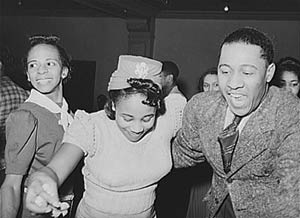
I'd rather party like it's 1941 or '42—Having fun at roller skating party at Savoy Ballroom.
Chicago, Illinois
.
Russell Lee, 1941

Brooklyn, New York.
Red Hook housing development. Jitterbugs at the community center party.

Arthur Rothstein, 1942
Photos: Library of Congress, FSA/OWI Archive

1941-2: people were back at work, advocates for their interests were among those in power, and things were about to change for the better.

Our Depression, Less Than Great

Drought refugee's car on U.S. Highway 99 between
Bakersfield and Famoso, California
.
Dorothea Lange, 1939
Library of Congress FSA/OWI Archive
Regarding our government's economic priorities, the routinely brilliant image and text of Driftglass' take on our own Depression—"Napa Valley Grapes of Wrath"—says it all.

With a new year ahead, I plan to start focusing on some more recent history.


In preparation for what's coming up in 2011.

12.12.2010

December Read: The Old Ideology's New Clothes

Tear Down This Myth: How the Reagan Legacy Has Distorted Our Politics and Haunts Our Future
Will Bunch; 2009

The Man Who Sold the World: Ronald Reagan and the Betrayal of Main Street America
William Kleinknecht; 2009
WPA/Federal Art Project: Newark, N.J., 1937 (Special Collections and Archives, George Mason University Libraries)
"Facts are stupid things," he famously mangled his line.

As the Reagan centennial approaches, two journalists bring up some stubborn facts—as did a few of their Reagan-era colleagues, back in the day.

One true thing about facts: they have a well-known liberal bias.

Something facts do not have: a lavishly-funded PR machine.

Reagan does.

Years before the man's death, efforts including Grover Norquist's "Reagan Legacy Project" set out to name every conceivable piece of public property after the man who encouraged Americans to hate government.

Will Bunch notes how, prior to Reagan's June 2004 funeral, former White House aides and advance men spent at least a dozen years pre-planning the televised week-long "'spontaneous' moment of national unity and shared grief."

When the day finally came, their prep work took the meticulously staged camera ops of the Reagan presidency to new levels of packaged spectacle, handed to a grateful corporate media.

Bunch quotes Richard Goldstein in the Village Voice—
Each gesture was minutely choreographed, every tear strategically placed.
It's all to be expected: the Right has the money to invest in perpetual image polishing of a "PR outfit that became President," in the words of a former Reagan press secretary quoted in both books.

Both authors run through Reagan's lies, distortions, and fantasies; the economic and social depredations his policies set in motion; the myths his PR machine has promoted.

And there was the Democrats' reaction to Reagan's "popularity"—actually, not so great, during most of his eight years in office. Yet the party leadership's acceptance of the notion was the beginning of the end for Democratic effectiveness at governing—or at even managing a coherent message.

Bunch credits Reagan' willingness, as California governor, to combine "red meat rhetoric with closed-door compromise." Bunch believes that Reagan as president was often a pragmatist, and praises him for starting to ease tensions with the Soviets. But this was after Reagan had recklessly tempted raising tensions, with his Evil Empire cracks and other shenanigans.

Reagan may have been a sentimentalist, willing to acknowledge the humanity of his putative enemies—if he got to know them personally. Or if he saw something in a movie, which seems to have been his mode of perceiving the world.

Bunch describes at length Reagan's reaction to the 1983 broadcast of The Day After, and how its scenes of nuclear holocaust in a Midwestern town motivated him to work for an arms treaty.

Too bad no one ever showed him a movie about a struggling single mother; one wonders if that might have made it harder for him to turn real Americans into imaginary freeloading welfare queens. But he wouldn't have wanted them to be flesh-and-blood: the vision of dark-skinned, overly fertile women conjured up by his tall tales was too politically useful.

Just as—before being re-branded a "sunny optimist"—he advanced his career this way:
In 1969, as he geared up for a second run at governor, the students of Berkeley provided Reagan with another opportunity. Students and community activists rioted over a patch of campus-owned land they called People's Park.

Reagan sent in the National Guard. The image of a Guard helicopter dropping tear gas on the campus sent the governor's popularity soaring.

The next year, anti-war demonstrations caused more protests and a riot at UC Santa Barbara.

"If it takes a bloodbath to silence the demonstrators," Reagan said, "let's get it over with."
And Reagan's campaign for the presidential nomination was launched here: a proud symbol of "state's rights," best known as the site of murders committed very nearly with impunity.

There was no regard for the public good in Reagan or his machine.

Days before the 1980 election, Reagan blew off his handlers' attempts to prep him for debating Jimmy Carter, so confident was he of winning over his TeeVee audience.

Carter droned on about dull subjects like Americans going without national health care, which Reagan had long opposed.

Reagan replied with his foolproof zinger: "There you go again."

Reagan became president not merely to ensure that "America still lacks the national health-care program that Carter spoke about." [Bunch] The real goal was to undo the New Deal. At the time, unthinkable; now, distressingly far along.

During the Depression, both books note, the WPA wages Reagan's father and brother earned were all that kept the family afloat. For a time, Reagan was grateful, and considered himself a loyal Democrat. Later, as his acting fortunes fluctuated, he made helpful connections with the rich and powerful—and learned where to find the best pay for his loyalties.

Both authors cover similar ground on the impact of Reaganism since the man left office. Bunch writes in detail about the operatives and media strategies behind the post-presidency myth-making accomplished in Reagan's name. Much of Kleinknecht's book is a condemnation of what nearly thirty years of Reaganism has done to the country. This includes a look at life in Reagan's home town of Dixon, Illinois, before and since those policies triumphed.

Kleinknecht notes the political role of new wealth by the 80s, in bringing Reagan to power and promoting attitudes that remade the country. Of new wealth as a class with a certain mentality, Kleinknecht writes—
... the breed of businessmen who had been closest to Reagan during his rise in politics... were the ranchers, oilmen, and developers of the West and the South whose fortunes had been made in the postwar period... Most had built their businesses from the ground up in the booming communities of the sun belt, which left them with a raw notion of free enterprise that would not have been out of place in the Gilded Age. The wealthy families that had made up the eastern Republican establishment may have cherished their tradition of noblesse oblige, but this class of capitalists had little time for such altruism.
The business figures behind Reagan's presidential run manipulated the soft money loophole in campaign finance law; their innovation was the funneling of corporate donations to local Republican parties as a way around federal limits.

The payoff: Reagan's administration would be filled by figures fresh from corporate boardrooms. Here too, was a pioneering practice, but soon to become SOP for the GOP: the naming of corporate foxes to guard the henhouses of those regulatory agencies they had fought throughout their careers.

The press secretary quoted above had spoken to Mark Hertsgaard, for his 1988 On Bended Knee: The Press and the Reagan Presidency. Bunch describes how—
The nonstop PR offensive spin got to be too much for one deputy White House press secretary, Leslie Janka, who quit in protest after reporters were barred from covering the 1983 invasion of Grenada. "The whole thing was PR... This was a PR outfit that became President and took over the country. And to the degree then to which the Constitution forced them to do things like make a budget, run foreign policy and all that, they sort of did. But their first, last, and overarching activity was public relations."
Bunch writes of the real-life consequences of the image machine—
The Grenada operations indeed proved to be the place where deadly force and PR spin first met. The Pentagon's decision not to embed any journalists with combat troops in the first couple of days of the asualt was unprecedented; with the public clamoring for any kind of information about the fight, the only initial video footage of the invasion was what the government fed to the TV networks... Grenada created a new war template—heavily sanitized, easily winnable, boosting the president's popularity... Top Reagan public relations aide Deaver later admitted to Hertsgaard that he had backed the Grenada assault because "it was a good story" and added that "I think this country was so hungry for a victory, I don't care what the size of it was, we were going to beat the shit out of it."

The jingoistic military moves, the glow of hyperpatriotism, and the pure plays for public emotion, held together by the glue of Reagan's personal popularity and skills as a performer in the public eye, were critical to cementing the president's popularity in the mid-1980s, because of a dirty little secret so rarely reported in the press. The majority of voters disagreed with Ronald Reagan on most of the major issues facing America, from the time he took the oath of office until the day he left.
Kleinknecht's final chapter, "The Second-Rate Society," aims to sum up where we are now, after so many years of living with
...the most destructive element of the Reagan legacy: America's utter loss of national purpose... By discrediting government as a legitimate and meaningful presence in the lives of Americans... By exhorting Americans to place self-interest above all, [Reagan] undermined the spirit of sacrifice and the possibility of a common effort to solve our most pressing national problems.
"Second-rate": too high a ranking? For a country that starves public education; turns children into a captive audience for marketers; then names schools for the person who did so much to get us to this state?

An unaccountable elite has had impunity in looting whatever is left to loot of a hollowed out economy. At the level of the lower classes, we see daily how the Reaganite CEO mentality has trickled down upon us.

Most of my work has been in public or private non-profit institutions, and ever since Reagan, bosses have been eager to imitate the corporate big boys. They may not have stock options, but post-'80s non-profit managers have been happy enough to give themselves raises by laying off staff. And long-time staffers who built an organization became targets for termination—just in time to head off their collecting pensions.

Then there are the more recent employee-screwing innovations, including foreign outsourcing of whatever institutional functions can be auctioned off.

As if to mimic corporate mass media's role in a dumbed-down culture, the institutions that should be guarding our heritage are instead trashing it—as in libraries being run by people who despise those old-fashioned, unsexy books, and can't get rid of them fast enough.

But this is all just the tip of the iceberg that is the true Reagan legacy.

That real legacy, joined to Republican control of public messaging, has been hard at work, ensuring that only correct thought will be heard publicly during next year's centennial.

A show brought to you by Our Sponsor.