3.13.2011

The Ronald Reagan Memorial Employment Plan

Entrance to Amalgamated Sugar Company factory at opening of second beet season. Nyssa, Oregon; 1939
Photographer: Dorothea Lange
Library of Congress FSA/OWI archive
No surprise that the jobs program is a closed door, for most of us.

But it's a great deal for all the former speechwriters and surviving members of his administration, what with their book deals and wingnut foundation gigs.

This Friday, Morning Edition gave nearly eight minutes to this, on the upcoming anniversary of Reagan's March 30, 1981 popularity surge.

Here, it's not a former Reagan staffer cashing in, but a WaPo writer (who happens to be married to an NPR correspondent). Wilber has detoured from his federal court system beat to devote 320 pages to "the day the shots were fired, and how Reagan managed to keep his sense of humor throughout the traumatic events."

Or perhaps, after a lifetime in acting, he never broke character.

We'll never have so much airtime devoted to Reagan's record, so we'll have to settle for this dewey-eyed piece, as it rehashes the operating room anecdotes of he who was dubbed by Gore Vidal, the Acting President.

The segment did have one revealing bit, in an interview with the Secret Service agent who got Reagan to the hospital—
"Since he did live and do what he did for those eight years, you can see the results of saving his life. And that's what our job is, saving lives... Before that event, even though there had been attacks on John Kennedy and Robert Kennedy and Martin Luther King [Jr.], a whole bevy of problems for the Secret Service, we still took a defensive posture. With this event we realized that wouldn't work anymore, and we did it in a flash. That's what came out of it..."
Threats to Kennedys and King: ehhh...
To Reagan: wake-up call!

On other job fronts, if Wisconsinites could fire Scott Walker today, they likely would.

His moves since day one in the Governor's office couldn't have been more obviously patterned on Reagan's career.

There was the attack on unions [see: President Reagan]. His earliest tactic was to threaten teachers and nurses with the National Guard, and his "budget repair" is, among many things, an assault on the University of Wisconsin [see: Governor Reagan, on both counts].

Walker may be unpopular at home—and subject to recall next year—but he'll never be out of work. He's got the media spotlight and big money behind him; a made man with a lifetime ticket to the right-wing gravy train.

All around the country, everyone else needing a job can expect the aid and compassion the great man himself always displayed.

Some quotes from Paul Slansky, The Clothes Have No Emperor: A Chronicle of the American '80s— [1982]
1/19 At his seventh press conference, President Reagan:
• Claims there are "a million people more working than there were in 1980," though statistics show that 100,000 fewer are employed
...
• Responds to a question about the 17% black unemployment rate by pointing out that "in this time of great unemployment," Sunday's papers had "24 full pages of ... employers looking for employees," though most of the jobs available…require special training, for which his administration has cut funds by over 30%.
3/16 "Is it news if some fellow out in South Succotash someplace has just been laid off, that he should be interviewed nationwide?"
—President Reagan—whose Presidency is based on the premise that people believe what they see on TV—complaining about coverage of the nation's economic suffering

4/15 "The statisticians in Washington have funny ways of counting."
—President Reagan explaining to Illinois high school students why, although the Bureau of Labor Statistics reported a rise in unemployment, he believes the jobless rate has in fact declined

9/4 "South Succotash, with its population of 11 million, must be a considerable place."
—AFL-CIO president Lane Kirkland on the unemployment figures

10/4 President Reagan suggests—and not, by any means, for the first time—that since he sees big help-wanted sections in the Sunday papers, unemployment must be caused by a lot of lazy people who'd just rather not work.

10/18 "Now we are trying to get unemployment to go up, and I think we are going to succeed."
—President Reagan getting confused during a GOP fundraising speech

12/23 President Reagan suggests that the key to solving the unemployment problem could very well be something as simple as hiring unnecessary workers. "If a lot of businesses ... could hire just one person ... it would be interesting to see how much we can reduce these unemployment rolls."
[1983]
1/18 "The President and Cap sit around and talk about how workfare got surfers off the beach in California. They have no concept of what is going on."
—Unnamed aide on President Reagan's failure to comprehend the seriousness of the recession
And some undated quotes:
THE REAGAN ADMINISTRATION TALKS ABOUT THE ECONOMY

"The number of people remaining in poverty is very small and it grows smaller every day."
—Domestic adviser Martin Anderson

"An increase in the number of people seeking work who did not find it."
—Larry Speakes on the cause of unemployment

"Just remember, for every person who is out of work, there are nine of us with jobs."
—President Reagan on the unemployment rate

3.12.2011

Laboratory of Plutocracy

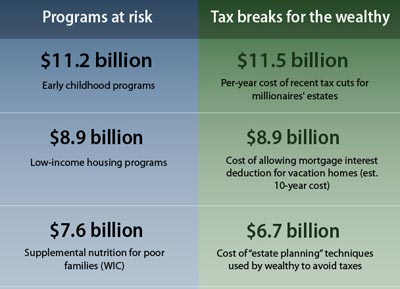
Just a portion of a much larger Center for American Progress chart illustrating the House's proposed budget: tax breaks for the elite, stolen from essential services for the poor and struggling.

While Kochs and the like have seen to getting their money's worth from the Congress they've purchased, they also have made sure that the staff at state levels are very busy, indeed.

Union-busting in Wisconsin and other states with Republican governors and legislatures is only one front in their class warfare.

The groundwork has been laid the groundwork by thirty years of propaganda joining the government-bad theme to CEO worship, to push the idea that government should be run like a corporation. No matter how the pretense works in reality—from the two terms of Decider Bush, to Wisconsin Governor Scott Walker's likely one-year tenure followed by recall—the necessity and unquestionable desirability of CEO government is the owners' message, long made into conventional wisdom by their political and media servants.

In real corporations, democracy is not the environment in which CEOs work their special magic. So Republican-controlled state legislatures are at work on any conceivable means of reigning in that pesky democracy, through the cherished GOP tactic of making sure the wrong people do not vote.

Of all the radical moves in all the laboratories around the country, Florida lends a particularly weird note.

Yes: it is Florida... Still, this guy?

An executive mansion, not jail, for someone who presided over the largest Medicare fraud case in history—and cannot even manage to pose for a photo without looking like the psychopath he clearly is.

But what we see is what Florida gets: an equivalent of Scott's previous career of doing "for hospitals ... what McDonald's has done for the food business"—
During Scott's tenure at Columbia/HCA, his cost cutting methods threatened patient care and safety:
- Susan Marks, a technician at one of Scott's hospitals, was forced to monitor 72 heart monitors by herself. Marks explained, "I have to. I've been told you either do it, or there's the door."...

- Scott downsized nursing staffs, created conditions where "babies were attended as infrequently as every three hours. Once, the only nurse caring for seven ill infants was so busy she failed to hear an alarm when a baby stopped breathing. A parent dashed to the baby and stimulated breathing, the state report said."...
...

In 2001, Scott would return to health care and the 'McDonalds model,' with a chain of urgent care clinics all over Florida. And as Tristam Korten explained in this two part series for Salon, it quickly replicated many of Columbia/HCA's favorite business practices.
This NYT story , Florida Republicans Are at Odds With Their Leader, at least has some amusing quotes—
"The governor doesn't understand there is a State Constitution and that we have three branches of government," said State Senator Mike Fasano, a Republican from New Port Richey who upset Mr. Scott with rough handling of his staff during a testy committee hearing. "They are talking about the attitude that he is still the C.E.O. of his former health care corporation, and that is not going to work in this state, in Tallahassee, in my district. The people believe in three branches of government."

...

"I think there have been some understandable growing pains because government doesn't function like a corporation," said Speaker Dean Cannon, a Republican from central Florida, taking a more measured tone than Mr. Fasano.

"I like Governor Scott a lot as a person and a leader," Mr. Cannon said. "I think he's going through the understandable adjustment of the transition from campaigning to governance."
"Transition"? To this guy, it means a fabulously golden parachute, as he moves on to plunder elsewhere.

Look out, Minnie! He's eyeing more booty than just your pocketbook!

Photo: Orlando Sentinal

3.11.2011

Revolution, Televised Or Not

AP Photo/Wisconsin State Journal, Steve Apps

Among all things wrong with our "news" media, the rush to fit complex events into predetermined narratives—before moving on to the latest piece of trivia—means ignoring the most gripping of stories.

The usual suspects may believe the Wisconsin story is over—that the manly Republicans won, and it's old news.

But the story has just begun.

The March 9 coup happened when I was offline for a few hours, but trying to digest a stack of printed material from the previous few days.

A very big development had been Michael Moore's speech at the Saturday (March 5) rally.

Last week Thom Hartmann started running daily reports from John Nichols in Madison, and those segments have been riveting.

This Monday, Nichols told the story of how Moore was writing something for his blog on Friday, when he decided that he had to go to Madison. A middle of the night decision led him to the airport; a few hours later, fire fighters escorted him to the rally—where what had been planned as a blog post became a speech before a crowd of at least 30,000 (or 10-20,000 more).

"America is NOT broke" was Moore's theme; some good excerpts are here:
... America is awash in wealth... It's just that it's not in your hands. It has been transferred, in the greatest heist in history, from the workers and consumers to the banks and the portfolios of the uber-rich.

...

...The smug rich have overplayed their hand. They couldn't have just been content with the money they raided from the treasury... They had to shut us up so that we could not even sit at a table with them to bargain about simple things like classroom size and bulletproof vests for everyone on the police force.
Moore may not have had media coverage, but the "uber-rich" took notice, undoubtedly finding the masses had expressed themselves quite long enough. The politicians they own soon dropped all pretense that the union-busting was about "budget repair," and staged an illegal vote in hopes of ending the scenes from the Capitol.

From Illinois, where he was with the other State Senate Democrats, Minority Leader Mark Miller issued a March 9 statement:
"In thirty minutes, 18 State Senators undid fifty years of civil rights in Wisconsin.

"Their disrespect for the people of Wisconsin and their rights is an outrage that will never be forgotten.

"Tonight, 18 Senate Republicans conspired to take government away from the people.

"Tomorrow we will join the people of Wisconsin in taking back their government."
Also from Moore's March 5 speech:
... Corporate America's fatal mistake. By trying to destroy us they have given birth to a movement – a movement that is becoming a massive, nonviolent revolt across the country...

America ain't broke! The only thing that's broken is the moral compass of the rulers.
After thirty years of class war, the undisguised power grab is there for all to see; this has the potential to be a real turning point, as people around the country observe Wisconsin's reaction.

It seems the other team picked kind of a bad place to pull this.

Sure, it's ironic that this year marks the 100th anniversary of the legislative session that made Wisconsin a national model.

Those legislative accomplishments of 1911 later inspired parts of the New Deal.

In turn, inspiring the hatred of those in the elite who refuse to be part of society, instead believing they deserves to control everything.

But in opposing those forces, Wisconsinites have the lessons of history, which many of them seem to remember.

Not that rulers give anything up without a fight.

In this country they have all the money and media to try making it go away.

A Ghaddafi is content to order a bloodbath.

And this week in Egypt, the army violently broke up peaceful protests—to stop evidence of torture and election-rigging from coming to light.

But events in Wisconsin are tremendously inspiring.

Citizens are in motion, with recalls and other actions being undertaken.

Tomorrow: a likely-to-be huge rally.

And—the farmers' tractorcade is on the way.

3.05.2011

Let Them Eat Ketchup

Somehow, I suspect funeral director campaign contributions behind this great move by Wisconsin's recently elected governor—Walker's Budget Slashes Medicaid, While Increasing Funeral Assistance For Destitute Who Die.

Scott Walker has been in quite the rush to become the new Reagan. The original model had eight years to defund social programs while projecting "sunny optimism."

Walker does not care about the human cost of his program; Reagan may or may not have been less heartless, but he simply refused to believe anyone in America went hungry.

Quotes from Paul Slansky, The Clothes Have No Emperor: A Chronicle of the American '80s—
[1981]

9/4 The Agriculture Department proposes cutting the size of school lunches... In addition, condiments such as ketchup and pickle relish would be reclassified as vegetables.

9/25 President Reagan—untroubled by the drop in stock prices "because I don't have any"—announces that he has withdrawn the proposal to cut school lunches. He suggests that a dissident faction in the Agriculture Department might have come up with the idea as a form of "bureaucratic sabotage."

Just to set the record straight, aide James Johnson explains, "It would be a mistake to say that ketchup per se was classified as a vegetable. Ketchup in combination with other things was classified as a vegetable." And what things would ketchup have to combine with to be considered a full-blown vegetable? "French fries or hamburgers."

[1982]

3/24 Agriculture official Mary C. Jarratt tells Congress her department has been unable to document President Reagan's horror stories of food stamp abuse, pointing out that the change from a food stamp purchase is limited to 99 cents. "It's not possible to buy a bottle of vodka with 99 cents," she says. Deputy White House press secretary Peter Roussel says Reagan wouldn't tell these stories "unless he thought they were accurate."

4/4 "If Mr. Reagan thinks he has to cut social spending to help right the economy, others might disagree, but he has earned the right to try. What he is not entitled to do is to cut spending for the poor and then claim that he is increasing it."
— New York Times editorial

4/22 The Reagan administration complains that the CBS documentary People Like Us—a Bill Moyers report on four people who have slipped through the President's "alleged safety net"—constituted a "below-the belt" attack on its economic policies. The network rejects a government request for a prime time half hour "to present our side."

[1983]

8/2 Claiming to be "perplexed" by continuing accounts of Americans going hungry, President Reagan establishes a Task Force on Food Assistance to explain it to him.

8/3 POVERTY RATE ROSE TO 15% IN '82, HlGHEST LEVEL SINCE MID-1960'S
— The New York Times

[1986]

5/21 President Reagan tells a group of students, "I don't believe that there is anyone that is going hungry in America simply by reason of denial or lack of ability to feed them. It is by people not knowing where or how to get this help." Asked what this observation is based on, Larry Speakes says, "That is his view." Critics note that the Reagan administration eliminated the program that informed needy people of available benefits.

6/11 President Reagan distinguishes himself at his 37th press conference by claiming that the government is providing 93 million meals a day to hungry Americans.
Bonus undated quote, from domestic adviser Martin Anderson—
The number of people remaining in poverty is very small and it grows smaller every day.

Reagan & Co: CEO Governance

In his 2004 Bottom Line: The true costs of Reagan and extreme capitalism, Sam Smith ranges over a world of hurt.

To show how expectations have been shifted since the '60s, Smith cites Lyndon Johnson:
"The Great Society rests on abundance and liberty for all. It demands an end to poverty and racial injustice, to which we are totally committed in our time. But that is just the beginning. The Great Society is a place where every child can find knowledge to enrich his mind and to enlarge his talents... It is a place where the city of man serves not only the needs of the body and the demands of commerce but the desire for beauty and the hunger for community."
That was in 1964: the same year Reagan said—
"We were told four years ago that 17 million people went to bed hungry every night. Well, that was probably true. They were all on a diet."
By the '80s, the stage was set—
Reagan was still just a brash voice for the wealthy, the greedy, and the lucky, a Bill O'Reilly with charm. But by the time he ran for president, the crudity and the covert cruelty had been transformed into a faith, a philosophy, and a political platform, in part due to a small group of rightwing economists and other academics, but mostly thanks to the new prime minister of England, Margaret Thatcher...

...

Reagan and Thatcher can not be blamed for everything that followed... for example, both Clinton and Blair were more effective in destroying their own party's traditions of social democracy than Reagan had been... Still it was Thatcher and Reagan that got things rolling. Every president and prime minister, regardless of party, who followed took their country further to the right.

What Reagan was up to was easily apparent to the modestly observant.

In 1985 Haynes Johnson noted in the Washington Post:
"His appeal has been to private instead of public interests, the self instead of selfless interests. Absent is any call for public service, for common effort, for shared sacrifice, for actions that extend beyond the gratification of the individual, for a wise perspective on the experience of the past and a clear definition of the unmet challenges of the future. The result of this sort of thinking leads to greater celebration of selfishness. It means a greater green light for a new wave of greed so evident in these mid-1980's."
Smith's 2004 piece includes material he wrote in 1985:
... I don't think even the president's critics are taking the Reagan phenomenon seriously enough. This is not just another bad president we're facing, but an administration that is attempting a massive revolution in economics, social and moral values, foreign policy, class and racial relationships, and civil liberties...

...We face a massive deficit and what does our president want to do to correct it? Increase still further military spending even at the cost of destroying programs that have been an integral part of American life for decades. Forget about the issue of priorities and think what this says about who holds power in this country. When people starve to feed the military machine, democracy is in deep trouble. In truth, the Reagan administration is an attempt to turn the military-industrial combination from a complex to a full autocracy.

Part of the problem stems from the cultural background of the Reagan elite; they are used to being bosses, they now have the key to executive washroom of the world, America, and damned if anyone else is going to get in. This executive suite mentality helps perhaps to explain why the Reagan people are so abysmal at the ordinary politics of compromise and negotiation. They're best at telling people what to do, only now instead of it being a branch manager it's a senator, an interest group or another once sovereign nation. Listen to them talking about why they won't help this or that segment of the population; their rhetoric is that of a CEO announcing the closing of a plant to improve the profitability of the company...
The CEO mentality at the highest levels of government was not new, as we know from the record of a former CEO who joined JFK's "best and brightest."

But Reagan's appointments and policies took things to an unprecedented level of transition to government by the corporations, for the corporations.

Besides the tangible evidence of toll caused by rising levels of unemployment and poverty in the last thirty years, it's important to note how cultural degradation has advanced the Right's agenda.

In a long list of the depressing statistics and other markers of where we are, post 2000, Smith writes that
- There has been a massive shift towards the language of capitalism in all aspects of our conversation and speech, making our words more clichéd, less meaningful, less enjoyable, and less human. To an extraordinary degree we now speak to each as salesmen rather than as fellow citizens. This makes for a pretty seedy culture, full of insincerity and deceit while short on cooperation, individual creativity and shared goals.

...

- Advertising has invaded every aspect of our life making existence increasingly one large commercial.
Broad brush, perhaps, yet uncomfortably familiar.

The environment created since the '80s has led to what Thomas Frank wrote about so brilliantly here: our living in a country where magical PR dust has turned capitalists into populists and union members into an elite. All while the employed have been subject to ever-increasing job insecurity along with ever-increasing demands for "productivity," as employers sought to indoctrinate workers to worship "change" and "flexibility." Demands that were made into an accepted cultural narrative, spread by a media that has hardly reported on labor for decades—except to denigrate unions as an archaic and declassé holdover.

Whether or not workers really fell for this stuff, there have been more than enough of them willing to vote against their interests, over and over.

It's a direct line from Reagan to Bush, and on to the current reality.

Republican-held state houses serving as laboratories for union busting and corporate enrichment, as in Ohio and Wisconsin.

While at the U.S. Capitol—
Republican leaders are using the deficits – which largely derive from the Republican policies that supported unfunded wars, unfunded subsidies for the richest Americans, and an economic disaster driven by the deregulation of Wall Street – to wage a war on working Americans. Far from helping hard-working, middle class Americans who have borne the brunt of the Great Recession, the House Republican budget targets those very same Americans.
The extremist House budget will kill jobs and slash funding for education, job training programs, student loans, and health care services for women and their families, among many other things. According to Mark Zandi, who advised John McCain's presidential campaign and who now works at the non-partisan Moody's Analytics, the GOP's proposed budget cuts will destroy 700,000 American jobs.
But as St. Ronald said, "We are trying to get unemployment to go up, and I think we're going to succeed."

3.04.2011

Constituent Service

Leading up to, then following the March 1 budget speech, Scott Walker's team had police limiting access to the Wisconsin Capitol Building.

The move contravened the state's Constitution, which requires the building to be open to the public.

And it was a move to reign in the reasonableness of the law enforcement agencies that have maintained the public's right to be in the building over the last weeks.

As Walker's actions have become more extreme, the County Sheriff has gone on record saying the State police had to take over, because "I refused to put my deputy sheriffs in a position to be palace guards."

Frustrated at constituents not being admitted to the building, Democrats moved desks outdoors, and hung a banner: "Assembly Democrats Are Open for Business."

John Nichols, on what drove them to it:
A judge has ordered the governor and his aides to open the Capitol.

... the governor and his aides have failed to comply with the order. Instead, they have restricted access so severely that, in the words of former Wisconsin Attorney General Peg Lautenschlager, they make a mockery of the state's tradition of open and accessible government.

"Opening the Capitol to the public does not mean letting one person in every three hours, as then restricting the movements of that one person once she is inside," explains Lautenschlager. "The governor and his aides are not respecting the judge's order; they are in contempt of it."
While this was happening, Walker's team was admitting their constituents.

That's going by what Nichols said on the Thom Hartmann show yesterday: the public was being admitted no more than one per hour, but the building was "swarming with lobbyists."

Perhaps they were from the bunch described here: ringers sneaked into the building to applaud the Tuesday night budget speech—
Nearly without exception, the west gallery was all men in black suits and, when the governor said something meaningful, they all rose and applauded, and they did it with verve and volume. I'm not saying these guys were not from Wisconsin, but if you know Wisconsin, you know for a fact that even for most businessmen, black suits are not part of the wardrobe. In general, the only time one will see a large gathering of Wisconsin men in black suits is at a funeral, or, apparently at a Governor Walker budget address.

There are so many fascinating aspects to the story.It's clear that Wisconsin expects open government, and that many citizens have re-thought voting for Walker, now that they've seen his Banana Republicanism in action.

Wisconsin elected officials can be subject to recall after one year in office. That gives Walker about ten months, but the campaign to start recalling his allies has begun.

And of the big picture—the real struggle ahead and the real hope—a wonderful piece by John Nichols: The Spirit of Wisconsin.

In Ohio, the course of events and possible remedies are very different, but a state referendum is likely to be the next move unions and Democrats make against the class warfare being waged by their governor and Republican majority legislature.

3.01.2011

"The Spirit Of Democracy Is Abroad In The Land"

Photographer Christopher Guess:
"the people's house" feels as much like a university student union as the government's legislative home.
Guess posts about the key organizing role played by the UW-Madison Teachers Assistant Association:
In Wisconsin, teacher assistants carry the same labor rights as state employees. The TAA has played a critical role in the organization of the protests running bus shuttles, doing food distribution, coordinating with police to prevent removal of signs and posters, organizing petitions, etc. Although they just lost their 24/7 access to this conference room where members where working and sleeping, they remain the "central brain" of the protest activity.
More Guess photos, in another post here.

That sculpture above commemorates the man; it's easy to imagine how palpably the spirit of "Fighting Bob" La Follette is felt at the Capitol these days.

Seventh-generation Wisconsin John Nichols observes—
This has happened before, of course. More than a century ago, Robert M. La Follette battled for the governorship in election after election until, finally, he beat the corrupt Republican machine and ushered in an era of progressive reform that redefined our politics for generations.

Just as La Follette had to fight the robber barons and their political stooges, so today's progressives are battling out-of-state corporate interests (including Koch Industries) and their local appendage, Scott Walker.

The fight will not end immediately, or easily. The "money power" -- as La Follette referred to it -- is arrayed to advance Walker’s legislative and political agenda. But the people power is on the march, as was seen last Saturday when a crowd that numbered well in excess of 100,000 protested in Madison, and tens of thousands of additional Wisconsinites went to their city, village and town squares to demand that the governor and the Legislature serve the people of Wisconsin as opposed to billionaire campaign contributors like David Koch.

As the progressives defeated the Scott Walkers and Paul Ryans of their day, La Follette declared that "the spirit of democracy is abroad in the land." But the great governor and senator warned against thinking that one election victory or one policy battle success would be transformational. "We are slow to realize that democracy is a life; and involves continual struggle," explained La Follette. "It is only as those of every generation who love democracy resist with all their might the encroachments of its enemies that the ideals of representative government can even be nearly approximated."
Meanwhile, in another part of the world Nicole Tung takes portraits of people standing up to a dictator.

Bloodshed is not over; yet, there's this—
Benghazi, Saturday, February 26: I was walking out of the main square where Friday prayers and protests take place — it's in front of the courthouse in Benghazi where the revolution effectively started. This guy couldn't have been older than 22 and he was leaning out of the sunroof of a car in this costume yelling and shaking his fists, imitating Qaddafi. Everyone who walked past laughed out loud. It was pretty extraordinary that this kind of mocking could take place so openly, and everyone could feel the lighter spirit and a weight being lifted.