1.29.2011

"How Ronald Reagan Changed My Life"

That's the title of a book by one Peter Robinson: former White House speechwriter, and one of the sizeable crowd riding the Reagan gravy train.

To quote from the Publishers Weekly review—
Robinson's self-help/memoir/Reagan hagiography is an All I Really Need to Know I Learned in Kindergarten for right-wingers. The former White House speechwriter… illuminates 10 life lessons in a love letter to the Gipper ("How," Robinson asks, "did such a nice guy get to be President?"). By looking at both the historical (supply-side economics, the Cold War, Iran-contra) and the personal (Reagan's beliefs, his relationship with his family), Robinson unearths maxims such as "Do your work" and "Say your prayers."
The real Reagan has been cleansed from the mainstream narrative.

The reality of his nasty domestic policies: war on the poor—and union workers. The start of a drastic redistribution of wealth upward that has by now all but finished off the working and middle classes.

And there was Reagan's foreign policy, including support of killers in Nicaragua—policy carried out by subverting the Constitution in the Iran-Contra end-run around Congress.

Facts that I want to get to in more detail, over the coming months.

But following Robinson's lead for now: some personal remarks about the feelings Reagan "inspires" in me.

Because Ronald Reagan certainly changed life for me—and the non-elite part of the country—and in ways not as lucrative as they have been for Mr. Robinson.

Before Reagan, I usually had minimum wage jobs—and lived perfectly well on them. In those days, it was common wisdom that rent should not be more than 25% of income; because the relationship between income and cost of living was realistic, it was not that hard to rent a nice enough place on minimum wage.

Along with changing all rules and reasonable expectations, Reaganomics fueled the real estate speculation and city neighborhood gentrification that killed "25% for rent."

Reaganism brought a multi-faceted attack on labor—including policies like raising tax rates for the bottom and taxing unemployment checks.

Thirty years later, with positions scarce and employers holding all the cards: I, like so many of those still employed, work in conditions constantly being made more unreasonable. And I'm one of the "lucky ones": my excessive workload keeps getting increased, but at least the pay has not been cut.

For me, a really telling thing about life before and after:
pre-Reagan, I never would have dreamed of buying lottery tickets.

In the years since hitting some numbers became the only way out, I sometimes throw away a couple of bucks, in search of feeling some hope for a few hours.

That chipping away at hope is the most insidious product of Reaganism.

The mainstreaming of what was once considered wacko Bircher ideology has been subverting our institutions for decades. And its use of hatred as a tactic of political control has had particularly painful effects lately.

I can remember being the age at which Christina Green was murdered.

As long ago as age nine was for me, I vividly remember my own idealism then: believing in the goodness of America, writing heartfelt entries for civics essay contests, and all that kind of thing.

Reagan's pitch that "government is the problem" has functioned as a form of terrorism, indoctrinating much of the public and poisoning our politics over the last thirty years. It has brought us this far into the rollback of the New Deal that Reagan's backers were always after.

Illinois Federal Art Project, 1937
Library of Congress

The poster is an optimistic reminder of an era when optimism was hard-earned.

Reagan is always touted as "a sunny optimist," but in his youth, families like his own gained hope in seeing they would get by, thanks to the government's helping hand.

Things gradually became better for so many; after the war prosperity grew, due to liberal policies like infrastructure spending and a progressive tax.

Post-war, things certainly went well for Reagan: well enough for him to become rich and turn on his past.

I grew up in a time when average families did fine on one income; prosperity for much of the populace was the legacy of the New Deal; and things were expected to continue becoming better, as a matter of course.

The long downward spiral began when Reagan's demonization of government was turned into conventional wisdom.

The chance of things improving in my lifetime feels less and less likely each day, and that's good reason for my resentment of the "sunny optimist" and his PR machine.

Along with the prospect of living wages, working in decent conditions, having a civilized society's access to health care and the possibility of retirement, "leisure time" is about as scarce as jet packs, monorails, or any other fruits of the glorious future predicted for us when I was growing up.

1.28.2011

In Labor's Corner

Clever Sister found this story: the January 10 passing of Ben Yomen, 99-year old artist and long-time cartoonist on labor and social justice topics.

The artist's site has his story and some examples of his work, and there's a book in print: In Labor's Corner: Political Cartoons By Ben Yomen

A longtime series of Yomen's featured the quintessential Dixiecrat politician of the 1940s and beyond, "Congressman Dripp":
Styles of headgear change; the themes never do.

The oily little man below is Thomas Dewey, whose platform Democrats once ran against, and won.

Some of these issues have changed. The "Isolationist" plank, in particular: Republicans had no trouble learning to love foreign adventures, once war was made safe for unlimited profiteering.

But there are also the evergreens, like "Bust Labor," and, bring back "Hooverism."

These and Yomen's other cartoons are still so timely.

And yet... after a thirty-year bludgeoning of American labor, it's not only clothing and graphic style that makes these start to resemble ancient artifacts.

The Road from Dixon, Illinois

... leads to Rockford.

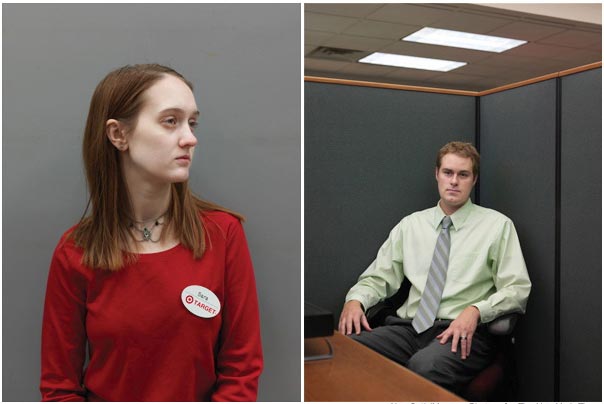
The birthplace of Ronald Reagan is just an hour from the other town, some of whose residents were featured on the January 23 cover of the New York Times Sunday magazine.

Alec Soth/Magnum Photos, for The New York Times

Caption: To illustrate the human dimension of the economy, the photographer Alec Soth traveled to Rockford, Ill., where unemployment is high. Above: Sara Carlson, 29, a salesclerk, and Andrew Jury, 28, an assistant vice president at a bank.

I saw these photos via Bag News Notes, where Michael Shaw muses on the visual aims of the magazine, in focusing on
... a group of people who had jobs; how secure these workers thought their jobs were; and what the workers felt their prospects were of hanging onto those jobs.

An illustration of the human dimension of the economy?

These images convey a troubling uniformity in their Stepford-like lack of affect. Far from the condition of insecurity, a condition we'd be able to tell through some form of fresh expressiveness, the only emotion I can really discern in any noticeable degree here is guardedness or self-consciousness.
The results certainly look like there was a decision to go for shots of depressed workers in (largely) dead-end jobs.

This is a far from gritty—and crusading—WPA photography.

But today: the thought of championing the Common Man—never mind the poor—would be in unthinkably bad taste. Which seems to leave only the sleekness of this portraiture; possibly an effort at visually branding our era's Depression.

Shaw's post is followed by some interesting comments on the esthetic of these photos, versus the more human dimension that comes through the Times' audio clips of interviewees.

The audio does give a very different impression of these workers, who struck me as a pretty representative cross-section of employed America. Some like their jobs; some believe they will do better someday; all are believers in Positive Thinking.

For me, the familiarity of these workers and their situations came through the audio. Which demonstrated just what is missing from the photos: smiles, whether real or masks.

Because employers demand those smiles. And employees, whether true believers or putting on a show for those who watch, have been conditioned to wear the smiles.

From the "have a nice day" customer service routine, to the expectation that employees must at all times show they are happy campers, ready to Embrace Change: we had better be smiling.

In the words of Dee, the 55-year old assembly worker, "If you do your job... don't cause problems: you'll keep your job."

Thirty years of Reaganomics have seen to the destruction of unions; the looting of the domestic economy, along with any semblance of security for most of us.

And then: there's the article linked to the cover portraits, "The White House Looks For Work."

This is White House correspondent Peter Baker's long piece about Obama's economic team. Baker's "reporting" on the process of determining policy is focused on the personalities and rivalries of "brilliant" figures like Larry Summers and Peter Orszag.

Summers looms "larger-than-life," as these players do, in any proper DC narrative. The article's unstated corollary is that the masses outside this heady atmosphere— including the ever-growing ranks of the long-term unemployed—are abstractions.

The article did note one piece of chutzpah I hadn't seen before—
Across Lafayette Square from the White House is the headquarters of the United States Chamber of Commerce. Last spring, four massive banners were hung on its building spelling out "J-O-B-S," a message presumably visible from the third floor of the White House, where the president wakes up.
Baker continues, "By fall, the chamber and Obama were at war during a midterm campaign that ended with repudiation of the president's party."

Stuff happens; let us not mention Citizen's United and the Chamber's role in vacuuming up billionaires' secret campaign cash.

Baker: "Given Obama's actions lately, [Chamber president Thomas] Donohue said 'he's moving in a direction that shows he's figured it out.'"

There's no doubt Obama has "figured it out"; "it" somehow seems to spell something other than "J-O-B-S" for ordinary Americans.

But that's the larger story of the road from Dixon: the triumph of Reaganism.

With its bipartisan endorsement of the corporate takeover of this country.

And the ease with which what's left of the working class has been conditioned to keep their mouth shuts.

And if they go to the polls: their willingness to vote for the people who will harm them the most.

1.25.2011

Bringing Good Things To Life?

State of the Union:

Unimaginable wealth for the few.

For the rest, something like Dickensian conditions—just with added technology. Which allows the bosses to constantly demand more of those whose jobs have not yet been exported.

Jack Welch's global war on workers led to rocketing share prices, which made him the "Most Admired CEO of the Century."


WPA poster, as revised by Micah Ian Wright
Propaganda Remix Project

Welch was followed at GE by this guy.

In the bipartisan corporate ideology of the last thirty years: Immelt's experience in demonstrating that ordinary Americans are too soft if they expect to earn a living wage and work under reasonable conditions makes him eminently qualified to fill us in on "Competitiveness."

If one company were to be singled out for doing the most to ruin this country, GE would be my pick.

There's the whole web of military, media, and financial industry involvement.

Reagan's political career was a creation of GE.

Someday, perhaps someone will combine it all into a Pynchonesque tale.

That would have to be a lot funnier than actually living with the product of it all.

1.20.2011

1985: The Reagan Show (Series 2)

Quotes from The Clothes Have No Emperor: A Chronicle of the American '80s;
Paul Slansky, 1989.

On January 20, 1985—
Not content to have his inauguration televised, President Reagan's aides inject him into the Super Bowl coin toss. The live feed linking him to Stanford is open ten minutes before he goes on the air, enabling satellite dish owners to spy on the leader of the free world as he:
• Practices the coin flip three times—"It is heads.... It is tails"—so he's prepared for all possibilities.
• Reveals a really neat idea a friend of his had—"Frank Sinatra had a recommendation, instead of tossing the coin, what would have been a lot better. You'd have had me outdoors throwing out the ball. I would have thrown it—a little artwork of maybe a ball going across a map—and out there, one of them catching a ball, as if it's gone all the way across the United States. How about that?"
• Stands immobile, almost deflated, as the minutes tick by, as if he doesn't quite exist when the camera's not on.

Finally, he gets his cue and—suddenly animated—he flips the coin. "It is tails!" he announces, adding some banality about how all the players should do their best. The network cuts away and, somewhat forlornly, he resumes the less satisfying non-televised portion of his life.
1/21 With the inaugural parade cancelled due to extreme cold, several high school bands perform for the Reagans at an indoor arena, where Nancy forgets to introduce her "roommate," then overreacts to this omission in Edvard Munch-like horror.

January 20, 1981: Under New Management

I was very glad to see today that the fiftieth anniversary of JFK's inauguration was a big news story. And it was refreshing to open windows throughout the work day and see the current Doodle.

But today also marks a day thirty years ago, when the country turned from the long liberal consensus to let "a smiling fellow" sell his Gubmint=Bad line.

"Foolish House":
Alaska-Yukon-Pacific Exposition, Seattle, 1909.
Photographer: Frank H. Nowell
University of Washington Digital Collections

Some quotes from The Clothes Have No Emperor: A Chronicle of the American '80s; Paul Slansky, 1989—for January 20, 1981—
Just before 9 A.M. Michael Deaver, stunned that the President-elect is still sleeping, enters his bedroom to remind him that he's "going to be inaugurated." Says Reagan, "Does that mean I have to get up?"

At noon, promising an "era of national renewal" Ronald Wilson Reagan becomes the oldest man to take the oath of office as President of the United States. As he completes his speech, the 52 hostages held in Teheran for 444 days begin their journey home.

Later, President Reagan visits Tip O'Neill's office, where the House Speaker shows him a desk that was used by Grover Cleveland. Reagan claims to have portrayed him in a movie. O'Neill points out that Reagan in fact played Grover Cleveland Alexander, the baseball player, not Grover Cleveland, the President.
Flashback: from the book's introduction—
"What kind of governor would you be?"
"I don't know. I've never played a governor."
- Ronald Reagan answering a reporter's query during his 1966 campaign for the California statehouse
Since 1966, Reagan has indeed had lots of on-camera experience, performing on an executive mansion set.

He immediately sets the standards for his two terms in the highest office in the land.

The grasp of issues and attention to policy—
1/21 At his first Cabinet meeting, President Reagan is asked if he intends to issue an expected Executive Order on cost-cutting. He shrugs. Then, noticing Budget Director David Stockman nodding emphatically. he adds, "I have a smiling fellow at the end of the table who tells me we do."
The tough talk... when he remembers his lines—
1/27 Welcoming the hostages home, President Reagan puts the world on notice that the US will deal with any such future incidents quite severely. "Our policy," he declares, "will be one of swift and effective retribution." When the band strikes up "Hail to the Chief," Reagan puts his hand over his heart. "Oh!" he says. "I thought this was the national anthem."
And, as celluloid Hero needs a Villain to play opposite: at his first press conference on 1/29, Reagan establishes his diplomatic stance toward the Soviet Union—
"Their goal must be the promotion of world revolution and a one-world Socialist or Communist state.... They reserve unto themselves the right to commit any crime, to lie, to cheat, in order to attain that."
Naturally, members of his administration quickly set the ethical tone for their own tenures.
On his first full day [1/21] on the job as National Security Adviser, Richard Allen receives $1000 and a pair of Seiko watches from Japanese journalists as a tip for arranging an interview with Nancy Reagan.

1.18.2011

What It's Always About

... Stopping the rabble's demands for rights,
as workers and citizens:

Caption:

From Oklahoma farm (April 1938) to strike leader in California. Cotton strike
(Nov. 1938).
He displays his union membership book.
"Vote No on No. 1" refers to proposed anti-picketing law which was later defeated by California electorate.

Kern County, California.


Photographer: Dorothea Lange
Library of Congress FSA/OWI Archive

John Nichols connects Martin Luther King's role in labor struggles—and 1968 assassination during his trip in support of striking workers—to the current attack on public employees:
The sanitation workers of Memphis had experienced not just racial discrimination but the disregard and disrespect that is so often directed at those who perform essential public services.

No one should miss the fact that AFSCME, the union that they joined and the union with which King worked so closely, is now under attack by right-wingers who would have us believe that public workers are to blame for the problems that occur when policymakers blow the budget on tax cuts for the rich, bailouts for big banks and military adventures abroad.
HTML Mencken's post on continued right-wing response to the Tucson shootings has a particularly good comment from Bilo—
Essentially, what the rageified Teahad and noise machine are saying is, This guy was just a nut, and all the violent & assassin-y language we've been using didn't cause it, so the prudent thing to do is for us to keep doing it until you can PROVE it has done it.

Except, well, it already has (Universalist Church.)

And in many ways, it's similar to their corporate masters' attitudes towards product safety, carcinogens, pollution, etc etc: Until you can PROVE, I mean, really, really, really PROVE that, how about we just keep doing what we want for another generation or three?