9.05.2011

A Late Labor Day

Late on the calendar this year.

At this point in our history: very late for any sort of break for American workers.

September 1942: Detroit, Michigan

Elderly women workers carrying banners in the Labor Day parade.
Photographer: Arthur S. Siegel
Library of Congress FSA/OWI Archive
These marchers may not have been as uniformly "elderly" as the OWI caption put it, but I'd say they were quite alike in feeling they were part of a social sphere with mutual interests.

With such quaint appeals as—
HOUSEWIVES! Ask for UNION LABEL GOODS

EQUALITY... END JIM CROW
—well, in the context of today's formerly working class finding its friends in Rush and Fox, it seems these women were not just elders, but lived in ancient times.

Labor Day 2011, Detroit: President Obama to speak before a union audience.

As this is in the context of Obama's supposed "big jobs speech," to come later this week, I'm afraid I'm with Matt Taibi, here—
... the people he's surrounded himself with are not labor people, but stooges from Wall Street. Barack Obama has as his chief of staff a former top-ranking executive from one of the most grossly corrupt mega-companies on earth, JP Morgan Chase. He sees Bill Daley in his own office every day, yet when it comes time to talk abut labor issues, he has to go out and make selected visits twice a year or whatever to the Richard Trumkas of the world.
There's the sad expectation that Obama will be making proposals to the extreme right of Dwight Eisenhower—who once wrote—
Should any political party attempt to abolish social security, unemployment insurance, and eliminate labor laws and farm programs, you would not hear of that party again in our political history. There is a tiny splinter group, of course, that believes that you can do these things. Among them are a few Texas oil millionaires, and an occasional politician or businessman from other areas. Their number is negligible and they are stupid.
But that's ancient history, too: 1954, when the views Ike criticized were those of a Republican fringe to be shunned. It would take a few decades for that fringe to invest enough money and effort to turn their program into the new bi-partisan "centrism"...

This year happens to be the tenth anniversary of Barbara Ehrenreich's Nickel and Dimed: On (Not) Getting By in America, and the author notes how much worse things are now.

There's enough truth in this, that it hurts when I laugh—
BEIJING (The Borowitz Report) – Labor Day, one of America's most beloved and longest-celebrated holidays, has been officially moved to China, U.S. officials confirmed today.

...

The transfer of Labor Day to China represents the first time in American history that an entire holiday has been outsourced, experts said.

"It may be just as well," said the University of Minnesota's Davis Logsdon, who has lectured extensively on Labor Day traditions. "It's been getting harder and harder for Americans to remember what labor is."

The Help

Genuine piece of a classifieds section; found marking a copy of Studs Terkel's 1974 Working.

Now there's a story Studs would no doubt have liked, though the background has to be guessed: disgruntled employee takes out ad, and, anonymously or not, spreads the word to check out Sunday's classifieds?

Still, this was the 1970s: lots of industrial workers had union protections—for that matter, we still had industries here.

For whiter (and pink) collars, this was before trends beginning in the '80s would catch up with us all. For those jobs not yet outsourced, most workers have lost ground. With the absence of raises; diminuition of benefits; demand for continuous increase in "worker productivity"—the class war has been won, through the management sticks and tricks with which we are beaten.

In other words, the "job requirements" of that '70s classified—"at least 4 years of college" to work in a "sweat shop" for "low pay" and "no benefits"—may have seemed a rude joke then, but predicted much about the workplace nearly four decades later.

And for the unemployed, the herd-culling grows ever more relentless.

Just a couple of recent posts from Digby, on the plight of the long-term unemployed—
Out-of work professionals as unemployables—because being unemployed makes them so unattractive to the buyers;

The story of one laid-off middle-aged worker, in a once working-class New York.
Just before this Labor Day: a columnist from Studs' hometown reminds us of Working, and of how much its author's voice is missed.

9.02.2011

1988: And In A Supporting Role...

Quotes from Paul Slansky, The Clothes Have No Emperor—

8/3 "Look, I'm not going to pick on an invalid."
—President Reagan coyly refusing to demand that Michael Dukakis release his medical records in the wake of completely false rumors that he twice got depressed and consulted a psychiatrist!

8/14 President Reagan arrives in New Orleans [for the RNC], where he calls the Democrats "liberal" 22 times in his arrival speech. "It's time to talk issues, to use the dreaded 'L' word," he says. "Liberal, liberal, liberal."

11/1 Campaigning in California, President Reagan quotes that well-known character from fiction, "Huckleferry Binn."

11/7 "So if I could ask you one last time, tomorrow, when mountains greet the dawn, will you go out there and win one for the Gipper?"
—President Reagan making his last campaign appearance on behalf of George Bush, whose half-hour election eve ad omits any mention of a Mr. Dan Quayle

1988: All In The Family

The expectation was that this guy would be irresistible to women voters—
The campaign was quite serious about that far-fetched assumption. Even so, you have to wonder whether GHDubya Bush might have had some misgivings—if he happened to notice anything familiar about his running mate, an untalented ne'er do well whose excellent family connections brought him so near the highest office in the land.

Though Quayle's connections have sustained him in a lifetime of lucrative right-wing activism, it's hardly worth the effort to cite examples of his vapidity during the 1988 campaign.

But there is that obvious comparison...

For these 1988 quotes from Paul Slansky's The Clothes Have No Emperor— just change the names and dates—
"He was as vapid a student as I can ever recall... Nothing came out of his mouth that was worth remembering."
—Dan Quayle's political science professor, Robert Sedlack, who said he would "inevitably think of Dan Quayle" when he heard the phrase, "The world is run by C students"

"Girls, golf and alcohol."
—Dan Quayle's classmate describing his majors

"Dan Quayle was one of the few people able to get from the Deke house to the golf course without passing through a classroom."
—Dan Ouayle's English professor

"He doesn't have the greatest smarts in the world."
—James Quayle, Dan's dad
Slansky also quotes James Quayle as saying his son's main interests in school were "booze and broads."

The quality of Quayle's own public utterances—
9/8 Believing himself to be at his best off the cuff, Dan Quayle dismays his advisers by abandoning his prepared text and delivering a rambling, incoherent speech that leaves his Chicago audience baffled. Among the highlights: his citing of the Tom Clancy novel Red Storm Rising as justification for building an anti-satellite weapon, and his citing of the philosophy of basketball coach Bobby Knight to support increased defense spending. Says an aide of this ad-libbing, "We didn't think he would deviate that far."

On the domestic front, he declares that Republicans "understand the importance of bondage between parent and child," though, of course, he means "bonding."
In 1988, at least one journalist knew the score—
10/18 Children's Express reporter Suki Chong, 11, interviews Dan Quayle for a PBS show about the candidates. "Let's suppose I was sexually molested by my father and I became pregnant," she begins. "Would you want me to carry that baby to term?"

"My answer would be yes," says the visibly uncomfortable candidate, who looks younger than his inquisitor.

"But, don't you think this would ruin my whole life?" asks the girl.

"I would just like to see the baby have an opportunity."

"So," says Chong, with a directness infuriatingly lacking in her older colleagues, "although you're not actually killing me, you would sacrifice my prospects for the future for that baby."

"See, I've gotten to know you just a little bit," says Quayle, "and you're a very strong woman. You're a strong person. And ... though this would be a traumatic experience that you would never forget, 1 think that you would be very successful in life."

Later, she asks Bush campaign manager Lee Atwater if the message the choice of Quayle sends is that "kids should get average grades in schools." Atwater claims Quayle "wasn't an average student." Replies Chong contemptuously, "Of course he was."
Idaho roadside attraction: Quayle autographe

1988: The Best Issues Focus Grouping Can Buy

From unpopularity to the presidency... with lots of help from the usual Democratic incompetence.

1988 quotes from Paul Slansky, The Clothes Have No Emperor—
5/26 With a Gallup poll showing their man 16 points behind, top Bush aides tell a group of pro-Dukakis voters some things they don't know about their candidate:
• His prisoner furlough program let a first-degree murderer out to commit rape
• He vetoed a bill that would have forced teachers to recite the Pledge of Allegiance
• His own Boston Harbor is really polluted.
Half of them become undecided voters, and the Bush campaign has found its themes.

7/21 "This election is not about ideology—it's about competence."
—Michael Dukakis accepting the nomination, exhibiting a dismaying misunderstanding of what every election is about

7/26 A Gallup poll shows Michael Dukakis leading George Bush 55% to 38%.

8/23 "If the Vice President is saying he'd sign an unconstitutional bill. then in my judgment he's not fit to bold the office."
— Michael Dukakis, trailing in post-GOP convention polls, but confident that this is all he has to say to put an end to that pesky Pledge of Allegiance issue

8/25 "I don't know what his problem is with the Pledge of Allegiance.... His fervent opposition to the pledge is symbolic of an entire attitude best summed up in four little letters: ACLU… He says—here's an exact quote—he says, 'I am a card-carrying member of the ACLU.' Well, I am not and I never will be."
—George Bush, uncowed by his opponent's cries of I "Unconstitutional!"

9/9 Surrendering to Republican pressure, [Speaker] Jim Wright announces that the Pledge of Allegiance will be recited in the House twice a week.

10/4 "The liberal governor of Massachusetts—I love caIling him that!"
—George Bush campaigning in Albuquerque

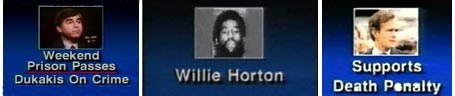
10/4 The Bush campaign begins airing a stark black-and-white spot featuring prisoners going through a revolving door. An ominous voice-over talks about "weekend furloughs to first-degree murderers" while misleading statistics about Dukakis' record on crime are flashed on the screen.

10/13 Michael Dukakis arrives at UCLA with one goal for the second debate: act like a normal human. He wastes no time demonstrating his inability to do so, answering Bernard Shaw's unusually blunt first question—"If Kitty Dukakis were raped and murdered, would you favor an irrevocable death penalty for the killer?"—with a bloodless recital of his opposition to capital punishment and the importance of fighting drugs. The race is understood to be over.

10/16 "Now, I'm having trouble with these questions, because they are putting me beyond where I want to be... I am focusing on November 8th, and I don't want to be dragged beyond that."
—George Bush taking reporters' questions for the first time in 18 days, annoyed that they keep asking what he'd do as President

10/19 "Friends, this is garbage. This is political garbage."
—Michael Dukakis finally fighting back, attacking an lIlinois GOP flier claiming, "All the murderers and rapists and drug pushers and child molesters in Massachusetts vote for Michael Dukakis"

11/6 George Bush rejects poll results showing most voters blame him for the negative tone of the campaign, citing instead "those personal attacks night after night on me, on my character at that idiotic Democratic convention."

11/14 "As we sat in front of our TV set, we realized that something had changed. No longer did the programming include, at regular intervals, footage of violent criminals going through revolving doors, recitations of the horrors that might be visited on peace-loving Americans if a 'card-carrying member of the ACLU' became President, or bursts of talk about Boston Harbor and 'Taxachusetts.' George Bush was not even President yet, and the United States was already a kinder and gentler place, because the Bush campaign was over."
—The New Yorker's Talk of the Town

8.28.2011

1984: The Ticket

Can't forget who was #2...
Art: Robbie Conal

Campaign quotes from Paul Slansky, The Clothes Have No Emperor—
9/10 Obviously irritated that his slippery position on abortion has become an issue, Bush refuses to answer any more questions on the subject, citing "my right as an Amerian to remain silent."

9/12 "There are an awful lot of things I don't remember."
—George Bush denying that his failure to recall his previous support for abortion poses a credibility problem

9/17 George Bush continues to respond testily to questions about abortion. "My position is like Ronald Reagan's," he says. "Put that down, mark that down. Good. You got it."

9/25 "Do you know what wins elections? It's who puts money into this and who takes money out. And the one good reason why Ronald Reagan is going to be re-elected is because he's putting something in here and the other people are taking money out."
—George Bush whipping out his wallet at a campaign rally

9/26 "I was up in New England the other day, campaigning in Vermont, and I said, 'It's nice to be here in Vermont when the sap is running,' and one of the pickets stood up and said, 'Stop talking about Mondale like that.' "
—George Bush campaigning in Indiana

10/3 Complaining that he'd been "singled out" and "taken to the cleaners," George Bush acknowledges that he recently paid $198,000 in back taxes and interest after an audit of his 1981 tax return. And why hadn't he revealed this before, especially in light of Ferraro's problems? "You didn't ask me about it."

10/4 "I'm legally and every other way, emotionally, entitled to be what I want to be and that's what I want to be and that's what I am."
—George Bush explaining why he considers himself a Texan even though he was born in Massachusetts, grew up in Connecticut, lives in Washington and pays taxes in Maine

10/10 "She's too bitchy."
–Bush aide Peter Teeley assessing the Ferraro personality

10/11 Geraldine Ferraro and George Bush debate in Philadelphia, with Ferraro putting on a surprisingly low-key performance and Bush an alarmingly animated one. Since the culture values noise and movement over quiet reason, the instant media analysis gives him the victory, though it's hard to find anything he said to earn it. Quite the contrary:
"Almost every place you can point, contrary to Mr. Mondale's... how he goes around just saying everything bad. If somebody sees a silver lining, he finds a big black cloud out there. I mean, right on, whine on, harvest moon!"
...

"Let me help you with the difference, Mrs. Ferraro, between Iran and the embassy in Lebanon We went to Lebanon to give peace a chance and we did. We saw the formation of a government of reconciliation and for somebody to suggest, as our two opponents have, that these men died in shame—they better not tell the parents of those young Marines."
—George Bush introducing the fatuous charge that Mondale and Ferraro have dishonored the memories of the slain Marines by attacking administration policies responsible for their deaths

"I don't think it's winnable. I was quoted wrong, obviously, 'cause I never thought that."
—George Bush denying that he told journalist Robert Scheer that he thought nuclear war is "winnable," though Scheer has him on a 1980 tape saying just that
10/18 Defending George Bush's assertion that Mondale and Ferraro had implied that the 241 Marines killed in Beirut had "died in shame," press secretary Peter Teeley says, "You can say anything you want during a debate, and 80 million people hear it." And what if he print media can prove that he lied? "So what? Maybe 200 people read it or 2,000 or 20,000."

11/2 "Under this President's strong and principled leadership, America is back with pride, patriotism and prosperity. We're Number One, and there's a lot of idiots who don't know that."
—George Bush responding to hecklers at a New Jersey rally

1984: Food, Wardrobe, Makeup

In quotes from Paul Slansky's The Clothes Have No Emperor, some things said and done during the campaign—

9/12 "The main difference between us and the other side is, we see an America where every day is the Fourth of July, and they see an America where every day is April 15th."
—President Reagan campaigning in New York

9/13 "The other side's promises are a little like Minnie Pearl's hat. They both have big price tags hanging from them."
—President Reagan campaigning at the Grand Ole Opry

9/19 "Only in 1984 could anyone who was part of Democrats for Nixon in 1960 go around parading himself as the new JFK."
—Ted Kennedy on President Reagan's constant quoting of President Kennedy

9/30 In an editorial signed by Walter H. Annenberg—at whose Palm Springs estate the Reagans have seen in the past quarter century—TV Guide urges its readers to re-elect the President.

10/7 In their first debate in Louisville, Walter Mondale clearly beats President Reagan, who terrifies viewers by demonstrating how he answers questions when his wife isn't standing next to him. In the course of 90 minutes, the President:
...
• Reprises his hit line, "There you go again," only to have it thrown back in his face by Mondale, who knows he won't be able to resist repeating it and is ready with a stinging rejoinder
...

• Claims that the increase in poverty "is a lower rate of increase than it was in the preceding years before we got here," though in fact it is higher

• Explains that a good bit of the defense budget goes for "food and wardrobe," becoming the first US President to so refer to military uniforms

• Admits, as he prepares to deliver his closing statement, ''I'm all confused now."
Afterward, a frantic Nancy Reagan confronts White House aides, demanding, "What have you done to Ronnie?"

10/9 "I'll challenge him to an arm wrestle any time."
—President Reagan attempting to shift the focus from his brain to his biceps

10/10 Still defensive about his debate performance, President Reagan says, "With regard to the age issue and everything, if I had as much makeup on as he did, I'd have looked younger, too." He goes on to make the surprising claim that he not only went makeup-free during the debate, but "I never did wear it. I didn't wear it when I was in pictures."

10/11 "Well, frankly, I know I made him up."
—G.E. Theater makeup artist Howard Smit, who, like Death Valley Days makeup man Del Acevedo, suggests that President Reagan misremembers the distant past

"He came by and shook hands afterward. It certainly looked like more than just a tan."
—Debate panelist James Weighart, suggesting that Reagan misremembers the immediate past

10/15 "What am I supposed to order?"
—President Reagan to an aide at a McDonald's campaign stop in Tuscaloosa

"Now, think about that for a minute. You fire the missiles. They come out of the submarine holes. They go through the water. They go through the air for several thousand miles. And then you decide you didn't want to fire them. So they stop. And then like a movie rolling backwards, the missile backs up, goes down through the water and back to the submarine holes." — Walter Mondale encouraging voters to contemplate the fact that the man with his finger on the button said nuclear missiles launched from submarines can be called back, though Reagan now claims he "never said any such thing"

10/21 At the second Reagan/Mondale debate in Kansas City, the President successfully delivers an obviously rehearsed one-liner—"I will not make age an issue in this campaign. I am not going to exploit for political purposes my opponent's youth and inexperience"—and thereby puts an end to fears about his recently displayed senility.

So determined are voters to ignore his flaws that not even his observation that Armageddon could come "the day after tomorrow" a comment that prompts Nancy to gasp, "Oh, no''') or his almost incoherent closing statement (something about a time capsule and a drive down the Pacific Coast Highway) can dissuade them.